The Ultimate Guide to Choosing a Web Studio

Imagine hiring a contractor to build your house. On paper, they look convincing. Their Instagram is filled with glossy renderings, and their sales pitch is polished. But months later, you’re staring at cracked walls, a leaking roof, and spiraling costs. Choosing the wrong web studio feels just like that: the foundation looks solid at first, but the structure can fail the moment reality sets in.
This guide is about avoiding that scenario. It will walk you through the same process one business owner, John, followed when he needed a new website — a process that saved him from wasting money on flashy but incompetent contractors and led him to the right partner.
Along John’s journey, you’ll see not just a checklist of questions, but the logic behind them. Because picking a studio isn’t about luck — it’s about clarity, structure, and discipline.
What You’ll Learn Along the Way
This guide isn’t just theory — it’s a process you can follow. By walking through John’s journey, you’ll learn how to:
- Spot the difference between studios that look good on the surface and those that actually deliver.
- Use a simple evaluation table to compare agencies side by side and make an objective decision.
- Track the latest design trends without getting trapped by “concept car” websites that win awards but fail in practice.
- Ask the right interview questions to uncover risks before they cost you money.
- Watch out for overlooked details — the small things that can quietly add months and thousands to your project if ignored.
Why This Guide Is Worth Your Time
Most business leaders aren’t designers or developers. And you don’t need to be. What you need is a clear process to choose partners who will make your project succeed — not waste your time and budget.
This guide comes from experience. Before starting new projects, we always ask founders and managers how they chose their last contractors, what went wrong, and what influenced their final decision. Across hundreds of conversations, the same lessons repeat.
That’s what you’ll find here — not theory, but a process tested in the real world. Half an hour of reading now can save you sleepless nights later — and tens of thousands in the long run.
Why this matters
For most companies, a website is more than a digital brochure. It’s the main storefront, the first handshake with investors, the touchpoint that convinces a customer to buy — or to leave. Choosing the wrong partner can cost months of wasted time and hundreds of thousands in lost opportunities.
Yet mistakes are common:
- Falling for ads. Google will happily sell you the names of the agencies with the biggest budget for paid clicks. But that says nothing about their ability to deliver.
- Choosing the cheapest bid. “Saving money” upfront often leads to ballooning costs later, as weak studios cut corners in QA, communication, or scope planning.
- Being dazzled by trophies. Awards like Awwwards or CSS Design Awards are inspiring, but too many sites showcased there are closer to concept cars than reliable vehicles. They win prizes for beauty — not for business results.
John realized early on that he didn’t want to learn these lessons the hard way. Instead of picking at random, he committed to a deliberate seven‑step process.
Why Listen to Us?
We are Digital Butlers — building digital products since 2016. For us, a website is never “just pages” — it’s a growth tool: for sales, for investor confidence, for brand trust.
- 600+ projects delivered in UX/UI, development, and complex platforms
- 27 experts worldwide across design, dev, and technology strategy
- Clients from startups to enterprises — including finance, automotive, media, and SaaS
- Recognized expertise: 76 design & business awards on Awwwards, CSSDA, FWA, and Clutch.
- Official Webflow Partner & Expert — trusted by the platform itself
Explore proof of our work: Full list of awards · Selected portfolio & case studies
A Few Highlights
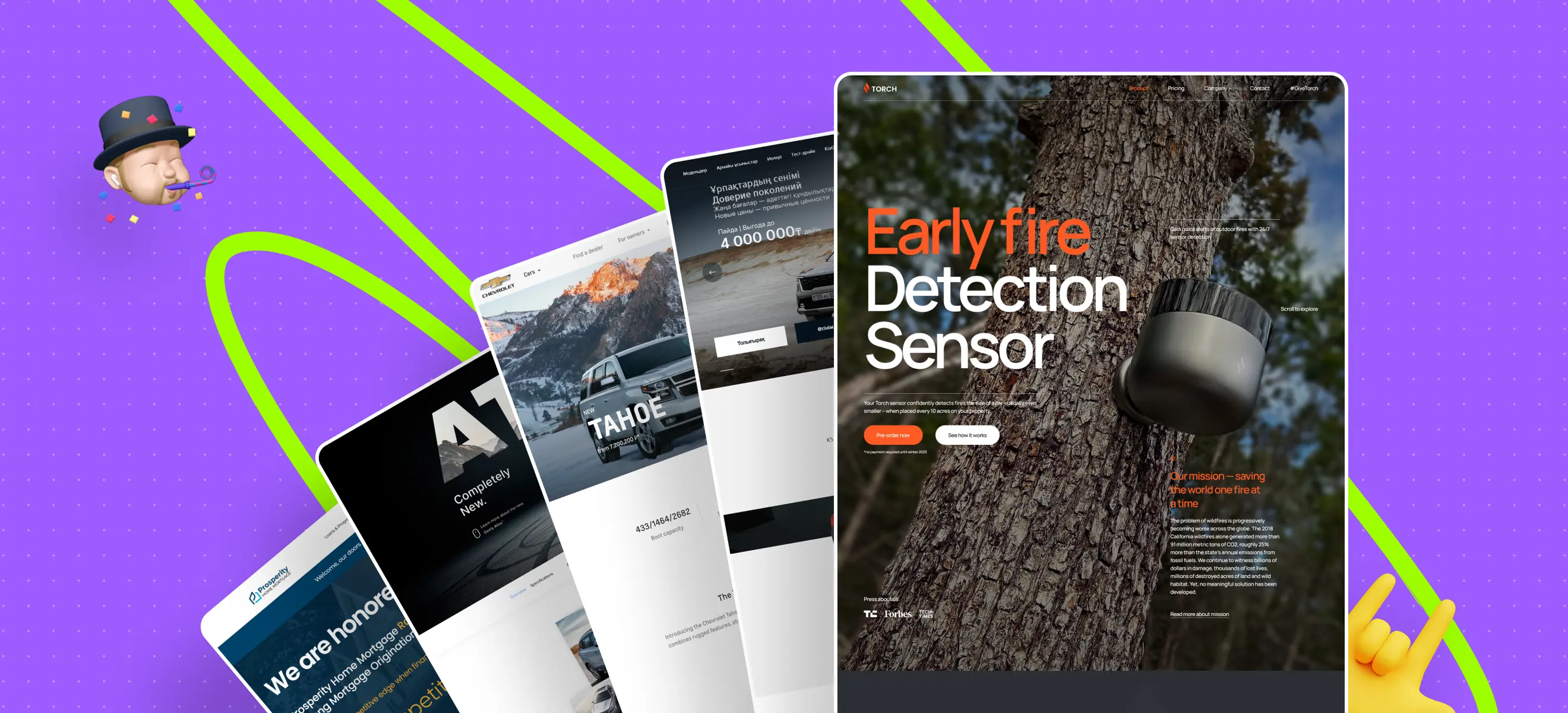
- Helped Torch Sensors launch an investor‑winning site for their fire‑detection technology.
- Built websites for U.S. mortgage leaders Prosperity Home Loans and Fairway.
- Delivered digital platforms for KIA, Chevrolet, and Geely dealerships.
- Created a car‑sharing service (KarShare, London) and an analytics platform (Calculum).
- Partnered with Plant Based News, the world’s largest vegan media outlet.
Bottom line: we’ve done this before. We know what works — and what doesn’t.
John’s journey begins
John runs a growing company and wants his website to do more than “exist.” He wants it to drive sales, attract investors, and represent his brand authentically. But he also knows choosing a studio can feel like navigating a crowded market, where every seller insists their product is the best.
So John treats the process like hiring a senior executive. After all, a studio isn’t just pushing pixels — they’re shaping his brand’s future. That requires methodical due diligence, sharp questioning, and a framework to compare candidates fairly.
Step 1. Studying the map before the journey
Before setting out, any traveler checks the map. For John, the “map” is design trends. Diving into platforms like CSSDA and The FWA gives him a lay of the land — what modern websites look like, how they engage users, and what innovations might apply in his niche.
But John soon realizes something important. Many showcase sites, especially on Awwwards, are digital “concept cars.” They’re sleek, futuristic, and eye‑catching — but impractical for day‑to‑day business use. So his takeaway is clear: inspiration is useful, but business goals come first. A website must not just look good, but work as a sales engine, storytelling medium, and customer touchpoint. Design without function is a liability, not an asset.
Step 2. Building the first shortlist
Armed with references from trend platforms, John starts thinking about actual partners. His first instinct is to search Google: “best web studios.” But a glance at the results makes him cautious. Sponsored links dominate, and the biggest spenders in ads are not necessarily the most skilled developers.
So instead, he begins by checking portfolios. He looks at:
- Past projects that resemble his industry.
- Case studies with measurable results.
- How the market talks about them — reviews, recognition, and consistency.
Soon, John assembles a manageable shortlist. Not dozens of names, but a handful worth serious consideration. The noise of the crowded market starts to quiet down. For the first time, John feels in control.
Step 3. Turning Ideas into a Clear Request
By now, John has a shortlist of studios. But before he reaches out to anyone, he realizes something: if I can’t explain what I want clearly, how can I expect someone else to build it?
So he sits down and formulates a project request — not as a shopping list of “I want animations and modern design,” but as a business problem to be solved.
Think of this stage like sketching a blueprint before construction begins. Vague goals lead to endless changes, ballooning budgets, and frustration later. Clear, structured goals act as a compass: they align studio proposals with what matters most to the business.
To make this easier, John uses a structured set of questions. Each one digs deeper into the “why” behind the website:
- What problem should your future website solve?
- How did you identify these problems?
- If nothing changes, how will it impact your business in terms of revenue, reputation, and overall stability?
- Which segment is the primary focus of your business, and why?
- What is your main product or service for the primary segment, and what problem does it solve?
- What does your company do after a customer purchases a product or service? Describe the process steps and resources involved.
- Who are your main competitors, and how are they represented online?
- What’s working well on your website? Which pages or sections are most important, and why?
- What’s working well on your website? Which pages or sections are most important, and why?
Answering these questions is uncomfortable at times — it forces John to confront aspects of his business he hadn’t fully thought through. But the result is clarity: when he sends his request to studios, the proposals he receives are grounded in reality, not fantasy.
This step alone already saves him from what he’s heard horror stories about: endless back‑and‑forth, endless revisions, and quotes that double halfway into the project.
Step 4. Preparing Interview Questions
With his request ready, John now faces the next challenge: how to separate great studios from good salespeople. Every agency sounds smooth and confident on their website. But the truth comes out during real conversations.
So John develops a structured set of interview questions — the same way he would if he were hiring a senior team member. In fact, many of his questions echo the hiring practices from the book Who: Solve Your #1 Problem, which Digital Butlers themselves use internally.
During the first meeting, John’s goal is to assess competence and reliability:
- Behind the pricing.
How do you calculate costs? Which past projects do you base estimates on? Have you worked on similar projects? How long did they take, and how much did they cost? — Here, vague answers are a red flag. If the studio can’t explain their pricing methodology, they might be guessing—which could lead to delays and cost overruns. A reliable studio bases estimates on past project data, not assumptions - Workflow clarity.
What are the project stages, approval points, and tools you use? Who will manage my project, and how many they’re currently handling? A studio that relies only on ad‑hoc messaging without structured tools (like Jira, Asana, or Trello) is a risk. And if the project manager handles too many projects, your project may not be a priority. - Interim checkpoints.
At what milestones will I see progress? What happens if I don’t like the design? How do we confirm design aligns with business goals? If a studio offers minimal approvals, John knows he might end up with a surprise he doesn’t like. - The team itself.
Beyond skills, does the team show curiosity, professionalism, and honesty about past mistakes? A candidate who “never failed” is usually one who never learned.
During the second meeting, once proposals are on the table, John checks the fine print:
- Studio’s technical planning.
Have they included QA, SEO basics, hosting setup, and blog migration? If the developer does their own testing, issues may go unnoticed—a dedicated tester is always preferable. Migrating a blog is a separate task. If you have a lot of content, confirm that the studio understands the complexity and includes it in the budget. - Design & Mobile Adaptation.
Do they preview mobile designs before development? What screen resolutions do they design for? If they don’t provide a mobile preview upfront, this could lead to major problems at the final stage. - Page Speed & Customization.
What page speed performance can we expect? If the site is built on a no-code platform like Webflow or Shopify, will it impact our ability to edit it later? If a Webflow site relies too much on custom code, it may limit your ability to make edits without a developer. - Final Questions Before Signing.
How do they handle project risks? Do they openly acknowledge uncertainties, or promise “no risks, no problems”? A good studio clearly defines responsibilities and explains what is and isn’t included. If they promise a perfect project with no risks, be cautious—you may encounter unexpected delays and budget increases.
This stage is about more than ticking boxes. It’s about reading the team: do they ask clarifying questions, or just try to impress with slides? Do they challenge John constructively, or agree to everything blindly?
What if this process feels overwhelming?
We understand that not all questions may seem obvious, especially for John who hasn't worked with web development partners before. No stress—we’re here to guide you. If things start to feel unclear, we can help by:
- Refining your project request—clarifying your needs and defining the right project scope.
- Explaining key concepts—helping you understand what really matters when choosing a contractor.
- Providing personalized recommendations—helping you find a studio that aligns with your goals and budget.
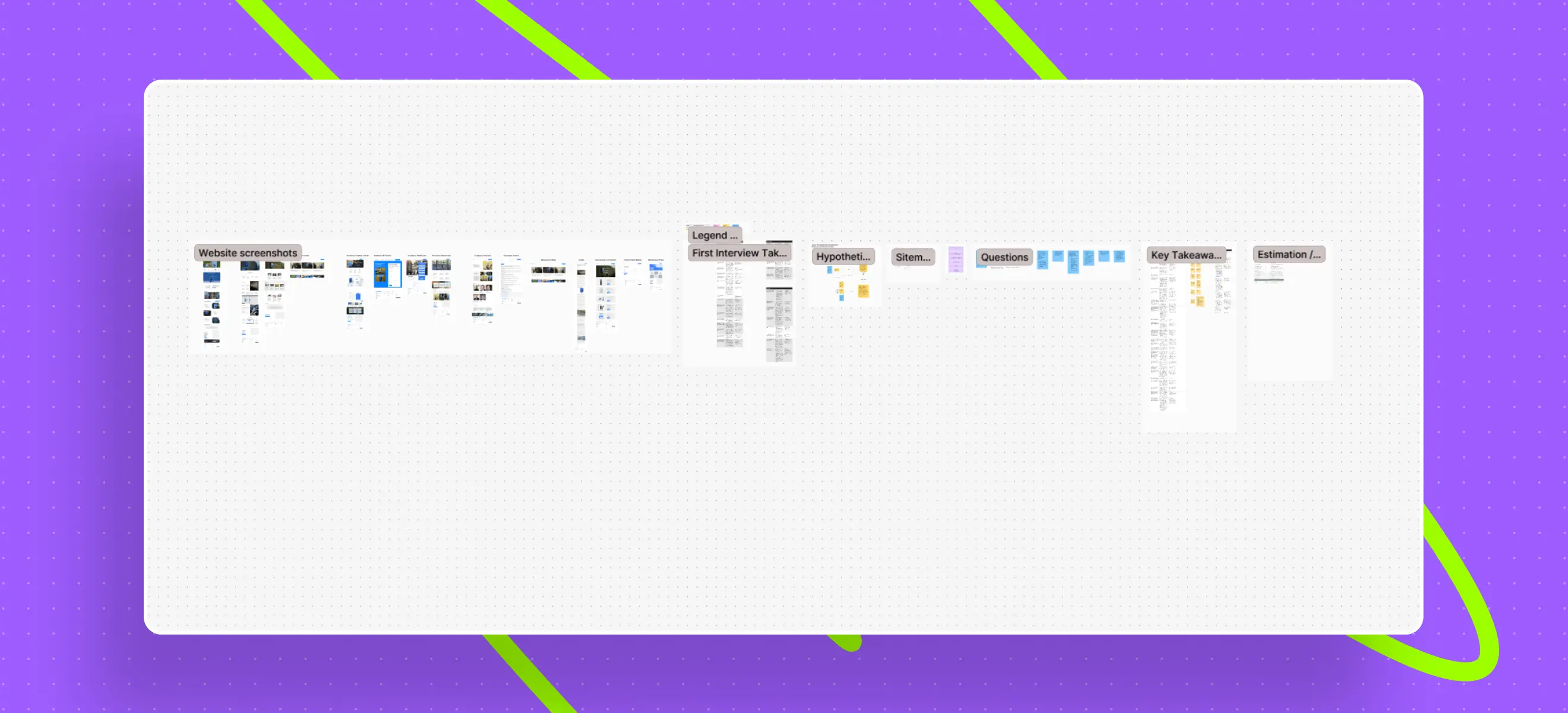
Here’s an example of a well-structured project request from an employer after completing the first and second meetings: visual Figma board
Step 5. Bringing the Shortlist to Life: The Interviews
For John, the shortlist is only the beginning. A portfolio can look good, a website can sound convincing — but the real truth about a studio comes out only in conversation.
So he schedules a series of structured calls. Each one lasts about 30–45 minutes. He blocks the time in his calendar, prepares his list of core questions from Step 4, and treats the meetings as seriously as hiring key executives.
During these interviews, John isn’t just listening to what the studios say — but also how they say it. The cues matter:
- Do they lead with curiosity about his business, or launch straight into a sales pitch?
- Do they ask clarifying questions that he hadn’t even considered?
- Are their answers structured and specific, grounded in past projects, or vague and inflated with buzzwords?
- Do they acknowledge risks honestly, or sugar‑coat everything as if no challenges exist?
John quickly notices differences. Some teams light up when he explains his vision — they ask about his clients, his goals, his competitors. Others simply nod and jump back to slides about “making it beautiful.”
The interviews become less about being impressed and more about partnership fit. Could he see himself working with these people for months? Will they challenge him if they think something’s not in his best interest? Do they listen well? These insights are critical.
By the end of this phase, John has more than opinions — he has detailed notes from each session, ready for the structured evaluation that comes next.
Step 6. Turning Impressions Into Data: The Six Criteria
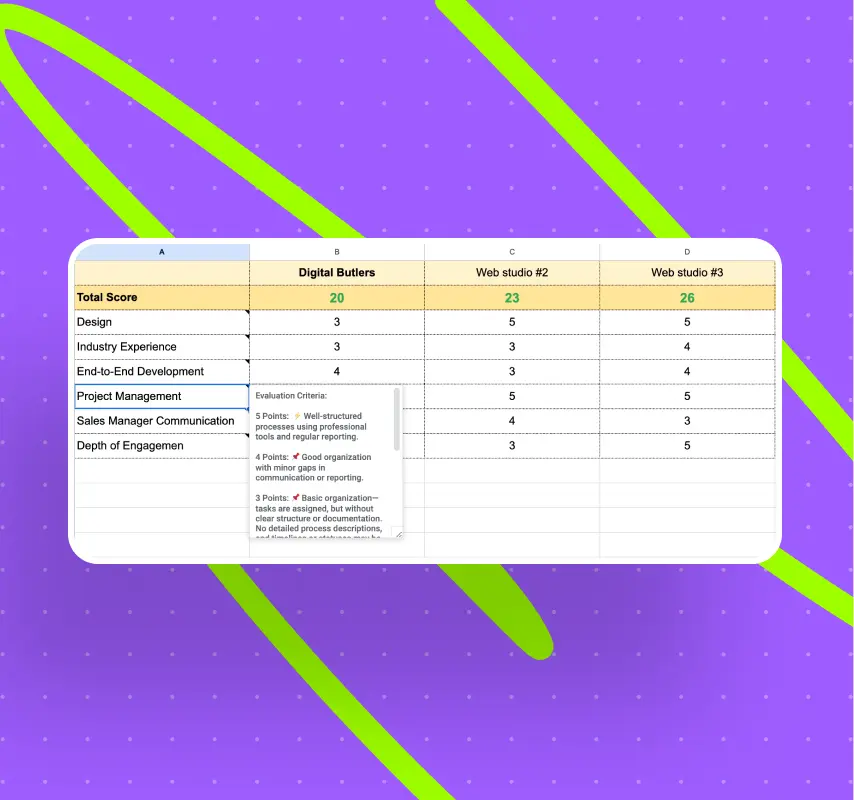
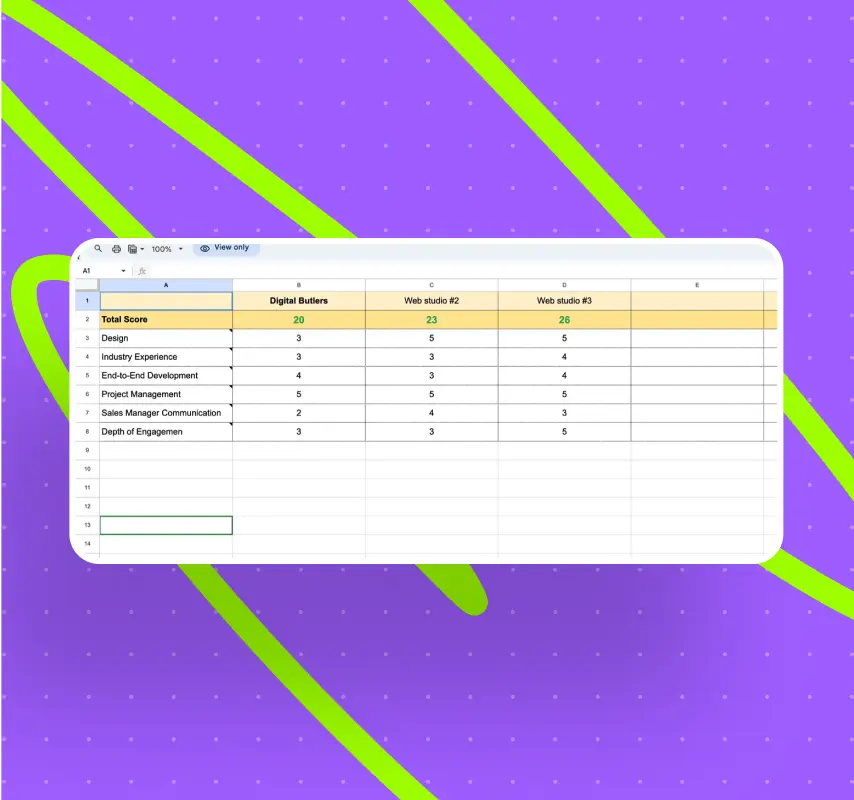
By now, John had gathered portfolios, spoken to teams, and compared proposals. But he knew this was the stage where emotions could creep in. A friendly call, a glossy mockup, a persuasive salesperson — all easy to influence judgment. That’s why he created his Evaluation Table.
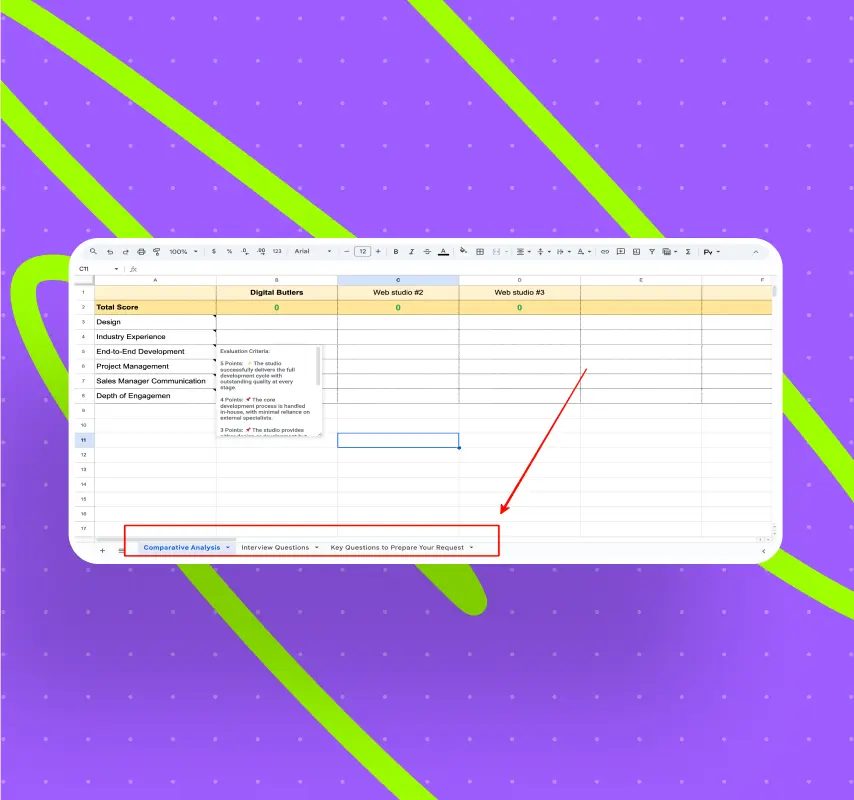
How Does the Evaluation Table Work?
- John listed all the candidate studios in one table.
- He rated each one across six key parameters on a 5‑point scale.
- The studio with the highest score would rise to the top, helping him make a confident, bias‑free final decision.
It was simple — but powerful. John had turned vague impressions into structured data.
1. Design Quality
John compared portfolios carefully. Instead of asking “Do I like it?”, he asked, “Does it work?”
- He watched for a balance of aesthetics and usability.
- He checked for industry awards — an external cue of quality.
- He confirmed whether the design style aligned with his company’s goals.
Each studio got a score from 1 (weak designs) to 5 (strong, business‑driven designs).
2. Industry Experience
John then weighed how deep their domain knowledge ran.
- Did they work in SaaS or at least in adjacent tech industries?
- Did testimonials mention outcomes in his niche?
- If the case studies weren’t clear, he requested references directly.
Studios with a shorter learning curve scored higher.
3. Full‑Cycle Development
John still remembered what happened when he hired a design‑only studio — chaos. Handling two separate teams created delays and finger‑pointing. Now, he only trusts studios that cover both design and development end‑to‑end. What John checks:
- Do mockups and live sites actually match?
- Are there real project links, not just screenshots?
- Is the site fully responsive on mobile and tablet?
If they didn’t, they lost points — he couldn’t risk fragmented teams.
4. Project Management
Even brilliant designers failed without structure — John had seen it before. So he dug deeper:
- Did they use PM tools like Jira, Trello, or Asana?
- Did they explain milestone approvals (moodboards → wireframes → key pages)?
- Were project managers overloaded, or balanced?
Chat‑only workflows raised red flags. Structured PM got rewarded.
5. Communication & Sales Process
John had learned that poor communication often tanked projects more than poor code. He watched carefully:
- Did they respond within 24–48 hours?
- Was the proposal tailored or generic?
- Were contracts clear, organized, and professional?
Polished communication became a proxy indicator of their internal process.
6. Level of Engagement
Finally, John scored how much each studio cared.
- Did they ask meaningful questions about his goals, competitors, and users?
- Did they challenge vague parts of his brief instead of nodding along?
- Did they reframe the work in terms of business outcomes, not dribbble‑shots?
The order‑takers failed here. The ones who acted like true partners? They got 5s.
Final Step: Making the Decision
When John finished his evaluation table, the winner was clear. Each studio had been scored line by line — design, industry experience, development, project management, communication, and engagement.
When he totaled the points, one studio pulled ahead. Not by luck, or by who had the friendliest sales manager, but because the numbers showed they were the strongest fit.
For the first time, John felt zero doubt. The process had stripped away bias and guesswork, leaving him with a partner he could trust to deliver.
With his top choice locked in, John was finally ready to move forward — confident he’d chosen a studio that truly aligned with his goals.
Conclusion
John’s story proves one simple truth: choosing a web studio isn’t about luck. Shiny presentations, low bids, or flashy awards might look appealing at first — but those are exactly the traps that often lead to failure.
What saved John was structure:
- He studied the market and understood the trends.
- Narrowed the noise down to a realistic shortlist.
- Built a clear request instead of a vague wish list.
- Ran interviews with tough but fair questions.
- Scored candidates on practical criteria, not gut feelings.
- Turned impressions into numbers — and let the data lead the way.
That sequence gave him confidence and clarity. Instead of relying on hope, he chose a partner with proof.
What to do next
- Use John’s steps as your roadmap.
- Download the evaluation template and test it on your top candidates today.
- Or save yourself weeks of trial and error and cut straight to clarity with us.
About Digital Butlers
We’re Digital Butlers — a design-led team of 27 senior specialists building digital products since 2016. By choosing us, you’re getting results that are way different from what you already have — with the same commitment to your goals that Alfred has for Batman.
If you need a website, web service, or mobile app that pays off, reach out to us — we do it well.
Digital Butlers — a mature team with mature processes that deliver consistent results.


Let’s discuss your next website.
My name is Alex, and I’ll help you define the right next step.