Figure out what you really need before you brief?

Imagine this: You’ve spent days (maybe weeks) polishing a technical spec. A thick PDF, dozens of pages deep. You attach it to your request thinking:
— "I'll just send this over, they'll read it, and put together an estimate. Everything's spelled out."
They review your spec, give you a number, you sign the contract — and then the project begins to fall apart:
— “Wait, that’s not how it was supposed to work.”
— “That wasn’t included in the estimate.”
— “We underestimated the timeline — we need three times more time.”
— “The budget’s gone, we need additional funding.”
If you’ve built at least one serious digital product, you’ve probably seen this movie before. And if I’m honest, my team and I have been in this situation more times than I’d like to admit — until we finally learned something painfully simple:
— until we finally learned something painfully simple:
Even the most beautifully written specification never answers everything. And the more detailed it looks, the more hidden gaps you’ll find once you start digging.
Take a recent case: a university sent over a complete documentation package for their student application platform. Everything looked “complete” on paper. Seven pages, with a user flow, criteria, and a neatly listed set of requirements — the whole thing.
But once we went through it — carefully, line by line — we found 79 unanswered questions. Seventy nine! From a seven-page document…
Here's the simplest one:
The requirements said: “The applicant’s name should be displayed on the homepage.” But according to the spec itself, the registration form collected only email addresses and passwords — no names anywhere.
So… where is the system supposed to get the applicant's name?
And that's just the tip of the iceberg. There are always dozens of such gaps. And if you don’t surface these gaps early, they turn into miscommunication, delays, blown budgets, and that sinking feeling that the project is running you — not the other way around.
This is exactly why we always start with a conversation.
A real one — built around 10 key questions that might look simple at first glance, but ultimately determine whether your product — a website, a web service, or a mobile app — becomes something that genuinely moves your business forward… or just another line item of wasted budget.
Hi, I’m Alex. I’ll be the one asking these questions after you submit your request. I know firsthand how crucial they are, and I’ll show you through real examples why it’s so important to dig deeper into these conversations, rather than just sticking to the specs.
10 Questions That Determine Whether Your Product Becomes a Growth Engine — or Another Version of the Same Thing.
🟣 Question 1. What exactly is your request, and what problem should it solve?
On the very first call, I often hear a ready-made “diagnosis”:
— “Our website isn’t working. We just need to rebuild it from scratch.”
— “Users keep telling us they don’t understand the app — we probably need a full redesign.”
If your request is built on real insight, research, or months of user complaints — great. But when it’s not, this is where things get tricky. Because this question — the very first one — is almost never as simple as it sounds.
Just like in medicine, self-diagnosis usually leads to the wrong treatment. Let me give you a quick example.
A few years ago, one company came to us with a clear plan:
— “We’ve signed a contract with a large mortgage network. We need a template website that we can clone for every agent. Each site should be personalized, but based on the same structure. And we want everything to run on Webflow.”
At that time, we didn’t yet have enough experience — or confidence — to challenge the idea. So we built exactly what they asked for. And two years later, after hundreds of sites went live, the weak points became obvious.
Each Webflow site cost $24 per month — multiply that by hundreds. Any design refresh had to be repeated manually across all sites. And even though the structure was templated, every agent still had unique content — so creating new pages required hours of manual work from a manager.
Eventually we stopped, stepped back, and asked the obvious question we should’ve asked on day one: “What problem are we actually trying to solve here?”
The answer led us to build a tiny web service — a Website Builder. A web service that didn’t require cloning at all but simply allowed the manager to upload an Excel file with all agent data, and within thirty seconds the system generated a full, personalized mini‑site.
That shift erased most recurring costs and let the team focus on things that actually mattered.
.webp)
This is what happened when we finally asked the right question: a tiny service that turned one CSV into hundreds of ready-to-go agent sites in minutes — saving time for the manager and thousands of dollars for the business in Webflow fees just to keep all those cloned sites alive. The tool later grew into full template management and even a video editor. If you’re curious, the project details are right here.
It’s an old example by now — mostly because we haven’t made that mistake ever since. That project taught us a simple rule we still follow today: never start building before we understand the real problem.
Since then, whenever we get a request like “We need to build X”, we first explore why that specific solution makes sense. And when you’re discussing a project with potential developers, unpacking that “why” yourself helps pressure-test your own solution — long before a single line of code is written.
📌 If you treat the wrong illness, you’ll spend money on a redesign — and end up with the same symptoms.
🟣 Question 2. How did you figure out the problem exists?
When I start unpacking what’s really behind a project request, I often discover that the “problem” hasn’t actually been confirmed — it’s based mostly on instinct. I can’t tell you how many times I’ve heard things like:
— “The site looks outdated.”
— “I think users find it inconvenient.”
— “Maybe the design scares partners away.”
These impressions aren’t wrong — they usually signal that something is out of balance. But over the years I’ve learned one simple rule: “it feels like it” ≠ data.
This part matters to me because once the new product goes live, I want you — and us — to see clear, measurable improvement. And for that, you need something more reliable than intuition. You need indicators you can actually track.
It’s completely normal if the initial request starts with a gut feeling. In fact, business owners often sense problems long before the numbers catch up. My advice at that moment: check your intuition against the data. If you don’t have analytics installed, connect them. If you do — open the reports and see whether the numbers support the feeling.
That’s why we start every project the same way: we make sure analytics are in place from day one. So by the time we launch a new platform or service, there’s enough data to compare “before” and “after” — and to understand what actually improved.
If you want to learn more about this part of our approach, you can dive into the How We Work page or the article What Happens After You Send Us a Brief.
🟣 Question 3. Which problem is the top priority?
It’s rare that a business faces just one clear issue with an obvious fix. More often, several challenges come up at once — and they all feel equally urgent:
— users might complain about a confusing flow
— conversion rates could be slipping
— partners may be pushing for a refresh of the branding or positioning
Each problem makes sense on its own. But taken together, they blur where you’re actually supposed to begin.
Let me share a story — one of our own failures that taught us why this question matters so much. We’re not shy about our mistakes. We’ve dissected them at retrospectives, turned them into checklists, and built habits to make sure they don’t repeat.
Once a company called Vitable Health reached out. It’s an enhanced Primary Care membership that makes it easy for US‑based employees to get high‑quality medical care. That was back when we used to send out commercial proposals instead of unpacking each request in depth, like we do now. We didn’t yet run our own audience research or take time to understand what employers actually needed — we mostly worked with whatever materials they had
Vitable came with a brand identity, prepared texts, and two problems:
— their website looked outdated
— the site was confusing, which hurt conversions
No one remembers how we prioritized those goals, but for some reason we decided the first one mattered more. And because the texts were “already there,” we assumed clarity would somehow take care of itself. So we focused on the “pretty part”.
And yes — the new website looked great. Sleek, modern, polished. But it spoke to the wrong people.
Vitable’s users weren’t tech-forward early adopters. They were everyday working adults who just needed something simple to understand. Our shiny, high-tech design didn’t connect with them at all — they couldn’t see themselves in it.
A year later, Vitable Health came back to us again. Not for design, but for front-end development of a layout created by another studio.
And guess what that team asked first?
— “Between your two goals, which one is the real priority?”
They built the design around the second goal — making the site simple and understandable for the actual user.
That single question changed everything.
Since then, we’ve made it a rule: before we touch a single pixel, we need absolute clarity on the main goal behind the request. Are we fixing a business problem? A communication gap? A perception mismatch?
Getting this right upfront saves weeks of work — and protects our employers from polishing a solution to the wrong problem. Because even the most beautiful design won’t help if it solves the wrong task.
📌 Only by setting priorities can you build a site that actually works. Priority = focus. Focus = results.
🟣 Question 4. What happens if you don't solve this problem?
At first glance, it feels like a throwaway question — but here’s why I love asking it: it reveals far more about your focus than you expect.
This question helps you figure out where your time, money, and team energy really make an impact. You can’t chase every problem — there are always more fires than hours in the day.
If something messes with your company’s stability, your team’s performance, or your own peace of mind — that’s where your focus should go.
But if you’re stressing over a low conversion rate or a messy product flow while your audience is still pretty small, maybe design isn’t the real issue. Maybe it’s marketing. Or sales. Or even finding the right product‑market fit.
In that case, doing a redesign would just eat up time and energy that could go toward something that actually moves the needle. And that’s totally fine. Being honest about what really matters right now is the fastest way to progress.When we ask this question, it’s not a test. We just want to make sure the thing you’re planning to fix is the one that actually needs fixing right now — so the time, money, and focus you put in actually pay off. Because there’s nothing worse than doing everything right… just on the wrong problem.
📌 So if you realize this isn’t the main issue at the moment — great. You just saved yourself time, energy, and budget for something that truly matters. But if it is the thing holding you back — that’s when we’re the right team to talk to. Priority = direction. Direction = growth.
🟣 Question 5. Who is your primary audience?
You can’t talk to everyone at once.
This is one of the most common traps: “We’ve got five segments, so the product should serve them all!”
But something built “for everyone” usually ends up speaking to no one. It’s almost always better to focus on one main character in the story — the one who actually brings in most of your revenue.
— If you’re selling jam-filled pies, chances are kids are your primary audience.
— If your audience is retirees — spotlight the cabbage pie.
And this logic applies just as much to complex products. The real key is answering honestly: who exactly are we selling to first? One business can have multiple audiences — but the language you use to reach them is different every time.
If you want to figure out who your primary audience is, I always recommend looking at real numbers, not hunches. Check who’s actually buying — and then see which group brings in the most revenue. Maybe one segment makes lots of small purchases, while another buys less frequently but spends big each time.
Guess which group should get your attention? It’s not about headcount — it’s about who’s keeping the lights on.
📌 A product can’t speak equally well to everyone. But it must hit the bullseye for at least one audience.
🟣 Question 6. What's the main product for that audience, and what problem does it solve?
Once we’ve identified the audience, the next step is to understand which product matters most specifically for them. In situations like this, I follow a simple rule: strengthen what’s already strong. Make it your absolute focus — and only then move on to everything else.
Think about it this way:
If 60% of all purchases come from Audience A, and 60% of their purchases are for Product B, that single combination already accounts for 36% of your total revenue. By putting more attention on that exact audience and that exact product, you’ll likely push that number even higher.
And just to be clear — this doesn’t mean abandoning other audiences or products. It simply means shining the brightest spotlight where it brings you the biggest return.
I learned this the hard way.
At the very beginning, my partner Paul and I tried to make our first website tell everyone about everything we did. We were afraid that if we didn’t list a service, potential employers wouldn’t know we offered it — and we’d lose opportunities. So we ended up with a site that listed all sorts of things, from design to outsourcing. It was overloaded and vague. We tried to appeal to everyone — and ended up resonating with no one.
Our conversion rate hovered around 2–3%, which is painfully low for a landing-style site.
Then we realized something important. Our homepage didn’t need to highlight outsourcing, for example. Yes, we do take on that kind of work — usually when other studios oversell and need trusted help to finish things properly. But those projects never come from Google or our site. They come from personal connections, from people who already trust us.
Most of our traffic — almost 80% — actually comes from Clutch. Those visitors aren’t random. They already know what they need, and they’re actively searching for the right team. So we rebuilt the site around that audience: simplified the user flow, moved everything irrelevant into secondary pages, and tightened the core message.
The result?
More qualified leads, a waiting list, higher rates, and growing revenue
📌 Think about this: if focusing on your main audience and main product worked for us — why wouldn’t it work for you?
🟣 Question 7. How is your sales process set up?
This question naturally builds on the last two. You already know who your audience is and what your key product is — but how do you actually sell it right now?
That’s what this question uncovers: where your sales process supports you, and where it quietly holds you back.
When we mapped out our own employer journey — from the very first message to a signed contract — it became obvious we could make the entire path much smoother simply by rethinking our website.
Here’s what helped us shift our thinking. A while ago, we joined a six-month coaching program called Sales for Nice People by Martin Stellar (highly recommended if you’re still sending out proposals and waiting, hoping someone will say yes). That program completely transformed the way Paul and I approached sales.
We realized something crucial: Our job isn’t to send pretty proposals. Our job is to build solutions that genuinely solve an employer’s problem.
So instead of firing off quotes, we started having real conversations. We ask questions, get to the root of the goals behind the project, and figure out the best path together. The proposals became a formality — because by the time they arrived, both sides already knew exactly what we were building and why.
And that’s exactly why I wrote this article — to make sure our first meeting is quick, productive, and gets you a reliable estimate with timelines and a budget we’re ready to back 100%.
📌 Now think about your own sales funnel. Where could we tighten things up — and help you close more deals?
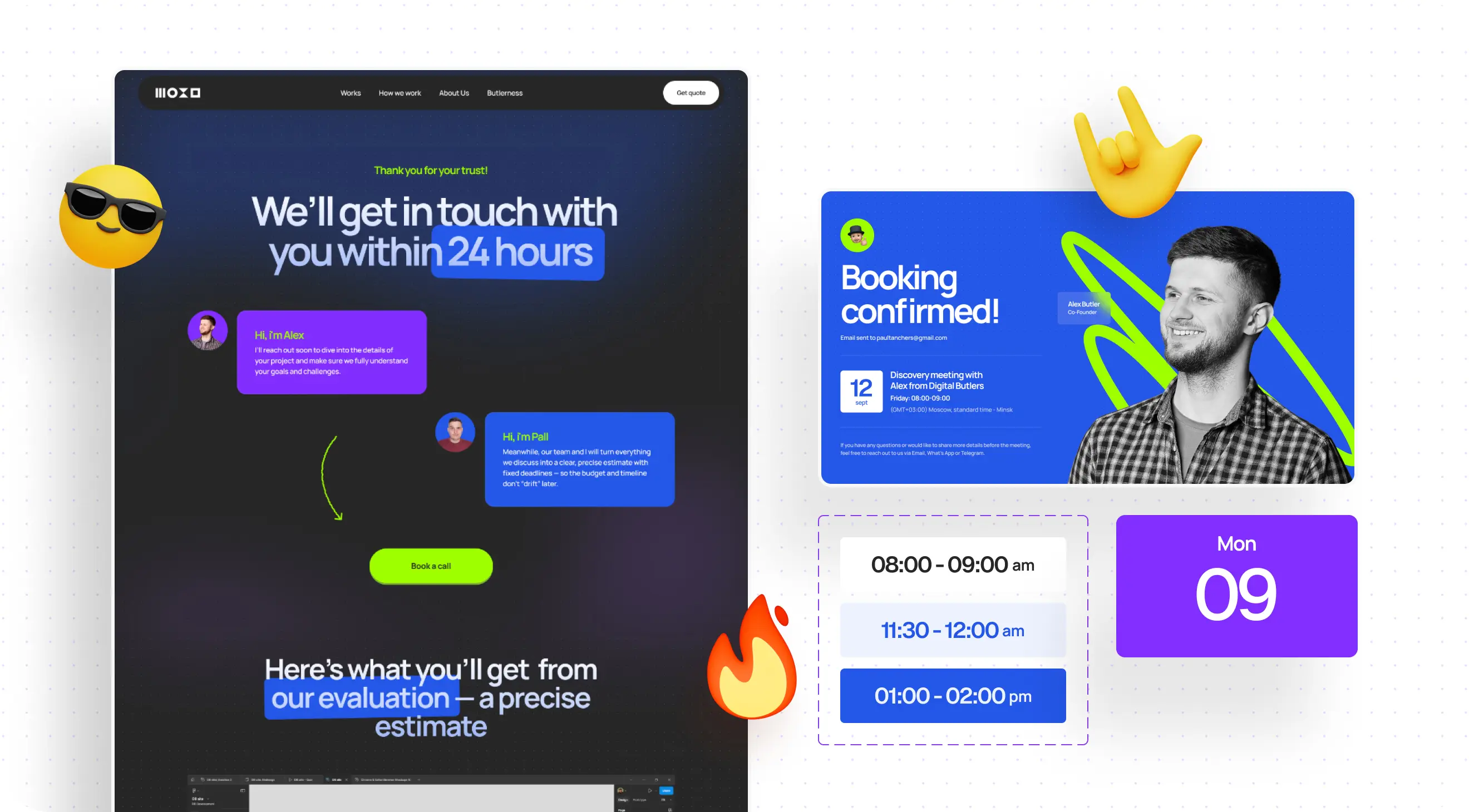
Here’s our Thank-You page, designed to guide people who haven’t read this article and don’t know we don’t send proposals without a conversation — straight to a meeting. Notice how different it feels from the rest of the site? That contrast is intentional. This page isn’t just a “standard” feature; it’s designed to work for us. How’s your Thank-You page working for your business?
🟣 Question 8. What happens after a lead or purchase?
Almost no one thinks about what happens after the request. Many assume that once the sale is made, the journey is over — but that’s exactly where you can make the biggest difference in your customer experience.
If new clients keep reaching out asking what to do next or how your product works, or your sales team is spending more time answering the same questions than actually selling, that’s a clear sign something’s missing — and your website or app can be the solution.
A good knowledge base, clear guides, FAQs, or short how‑to videos can instantly take that load off your team. Customers get answers faster, and your managers finally have time to focus on what really matters.
Or here’s another idea: After checkout, use that moment to strengthen the relationship — with something personal and useful. It could be a small bonus, a quick guide with pro tips, or a referral offer that rewards both the buyer and their friend.
Keeping your current customers happy — and giving them an easy way to share their positive experience — is almost always cheaper than chasing new ones.
📌 A good website or app doesn’t just bring in new customers. It helps you keep them.
🟣 Question 9. Who are your competitors, and how do they show up online?
This is a question many employersunderestimate. Since I’m the one who leads all our interviews, I know firsthand that conversations about competitors usually go one of two ways:
— “We don’t look at competitors, we’re unique.”— or the opposite
— “Just check what others are doing and make ours look the same.”
Both positions sound reasonable, but in my experience, the truth lies somewhere in between. Users are already used to certain patterns — layouts, features, even the tone of communication. That’s why we always start with a quick competitor map: we check out 5–10 websites or apps in your niche and note what keeps repeating.
If everyone has a calculator, users will probably expect yours to have one too.
If every site features an extensive FAQ, people might feel lost without it.
But competitor analysis isn’t about copying. Copying a competitor means copying their mistakes as well.
And remember our first website I mentioned earlier — the one with a 2–3 percent conversion rate? It performed terribly. But you should’ve heard the compliments we got for it! Let’s just hope no one decided to copy that one 😅.
📌 Our job is to understand audience habits — and then design something familiar enough to feel natural, yet distinctive enough to stand out.
🟣 Question 10. Which elements on your current site or app can't be lost?
After studying competitors, it’s tempting to focus only on what’s new. But redesigns sometimes fail not because of what’s added — but because of what gets removed.
That's why we always ask: which elements are working right now, and absolutely must be preserved?
For example, on our previous websites, almost 20 percent of all incoming requests didn’t come from the homepage or the contact page, but from a few old case studies — written ages ago and still quietly driving leads. When we discovered that, we didn’t just keep those case studies in the redesign; we doubled down on them. We restructured the section, started writing new ones, and even involved designers to create visuals that told the story.
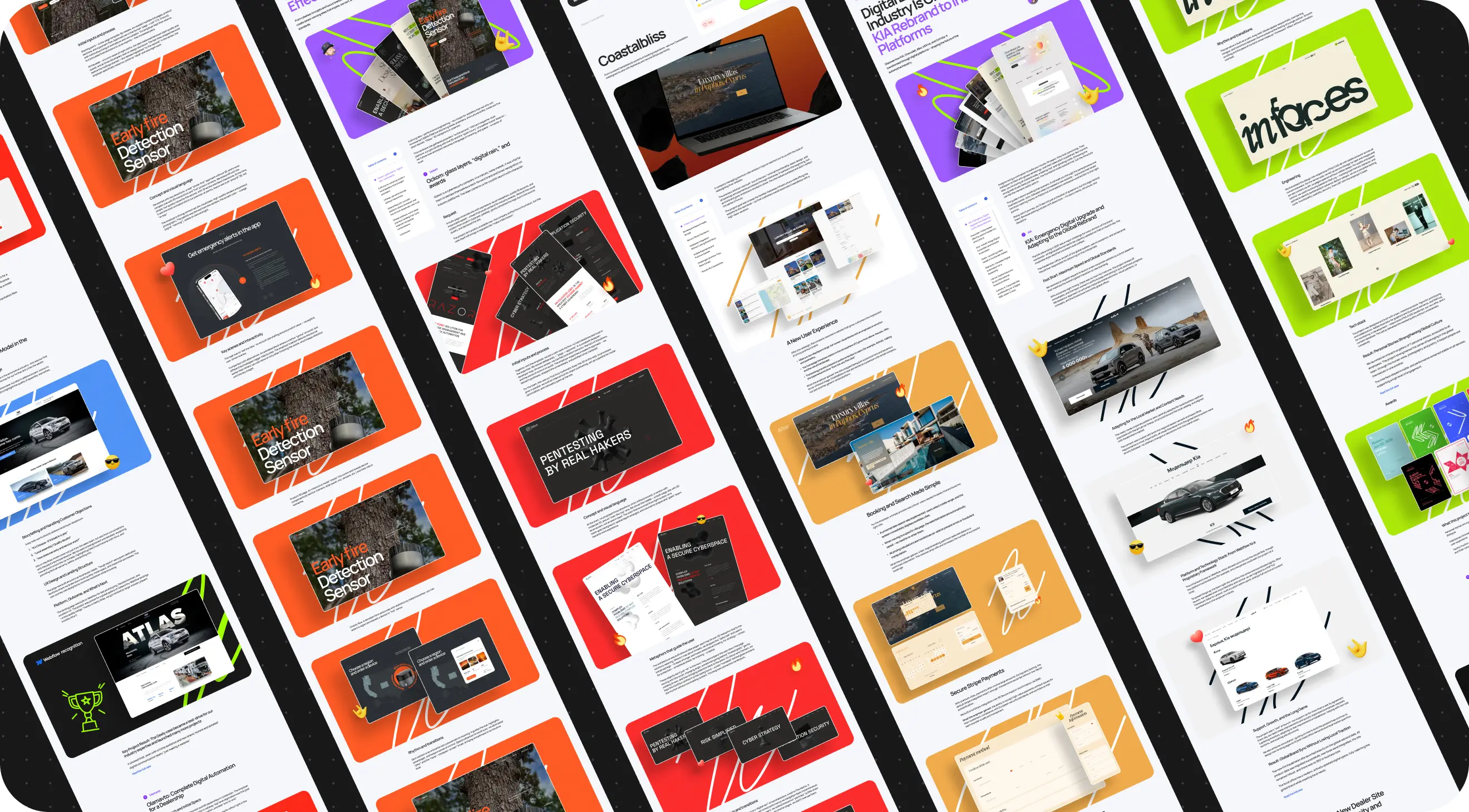
Realizing a significant number of our leads came from case studies, we redesigned the template for clarity and hired a dedicated copywriter to continuously create them. Previously, I wrote them in my spare time, so updates were rare. We also created niche-specific case studies like Automotive, Real Estate, Award-Winning, and Web & Mobile Apps to boost their effectiveness.
So take a moment to think: what’s already working well for you right now? It might be something tied directly to conversions — or something less obvious. For example, if your product requires assembly instructions, removing or hiding that information during a redesign can easily frustrate customers, even if it’s not part of your “sales” funnel.
📌 A solid redesign isn’t about changing everything. It’s about knowing what not to change.
Wrap‑Up and Invitation
And here’s the real point. This article isn’t a homework assignment — nobody expects a 20‑page specification. Even if you already have a detailed PDF with requirements, make sure you can still answer these ten questions — that’s where the real foundation of the project begins.
If you prepare even rough answers in your head, the meeting will change completely:
- The conversation moves faster,
- The estimate becomes more precise and more accurate,
- The new product aligns with your real business goals, not someone else’s template.
So, here’s what happens next. Reach out and book your first meeting. During that conversation, we’ll dive into the questions that really matter for your audience, your product, and the unique business context you’re in right now. After that session, you’ll get a genuine proposal from us — not a glossy, one‑size‑fits‑all PDF full of random numbers, but a clear, actionable plan for solving your challenges or hitting your goals.
📌 Most importantly, your site or app stops being “just pretty pixels.” It turns into a working business tool — and tools only perform when they’re built for the real job.
Conclusion
Understanding the true goals, context, and needs of your project is critical for its success. When talking to different studios, pay close attention to how they approach the conversation. If they’re more focused on showcasing their own success and expertise rather than asking insightful questions about your goals, it’s a red flag. This could signal that they are more interested in closing a deal at any cost than helping you achieve your objectives. On the flip side, if you’re unsure about the answers to these questions or if your responses are vague, it might indicate that you’re still in the stage of testing hypotheses and gathering information. In this case, the success of your project may not be the end result, but understanding the path to reach it on your next attempt.
Phew, I think that’s everything for now! In the next article, we’ll show you what actually happens after you send in your brief — what we look at, how we think, and what you can expect from the process.
Loyal to you,
Alex from Digital Butlers
About Digital Butlers
We’re Digital Butlers — a design-led team of 27 senior specialists building digital products since 2016. By choosing us, you’re getting results that are way different from what you already have — with the same commitment to your goals that Alfred has for Batman.
If you need a website, web service, or mobile app that pays off, reach out to us — we do it well.
Digital Butlers — a mature team with mature processes that deliver consistent results.


Let’s discuss your next website.
My name is Alex, and I’ll help you define the right next step.