What Happens After You Send Us a Brief?


In this article, you’ll see exactly what happens after you reach out. I’ll walk you through each step so you can understand how we ensure your project stays on track, within budget, and on time.
I’ll even show you screenshots from our Figma board, so you can see the behind-the-scenes action as we evaluate your project. You’ll get a firsthand look at how we turn your ideas into a clear, structured MVP product — with fixed timelines and budgets that we fully stand behind
By the way, I’m Paul
And I’m not just the guy behind these words; I’m actively involved in evaluating every project we take on.
You’ll first meet Alex — he’s the one on the front lines, the first person you’ll talk to. He’s the expert in getting to the heart of your goals, understanding your resources, and figuring out the context of your project. Alex will dive deep into your vision, ask the right questions, and make sure we’re on the same page about what matters most to you.
Then, I take that information and translate it into a solid project structure, timeline, and budget — all based on real data, past experience, and the expertise of our team.

Alex (on the left) is responsible for conducting interviews and negotiations, helping to uncover the essence of tasks and finding solutions for employers. Paul (on the right) structures ideas and turns them into clear strategies, coordinates team efforts, and ensures smooth execution.
How Not to Fall for a Shiny Proposal That Could Cost You $45K - Real Life Story
A few years ago, if you’d approached us and submitted your brief, within hours you’d probably have received a shiny PDF — a little about our approach, a little about us, and the star of the show: the number.
Back then, we were all about guessing that number — making sure it looked good: not too much to scare you off, but not too little for you to think we were just a bunch of rookies without experience.
What we didn’t do was ask the right questions. We didn’t consider whether the solution you described in your brief was the right fit or whether it would truly solve your problems. And we didn’t think about how we’d actually implement the solution you envisioned.
Instead, we focused on making the proposal look impressive — something to make you say, “Wow, they really know their stuff,” and get you to respond with, “You made it to the shortlist. Let’s talk.”
But then we learned the hard way.
It started with a modest contract, around $15,000. We were excited. But just two weeks into the project, it became clear we’d made a huge mistake. The $15K didn’t even come close to covering the real cost — we’d misjudged by over 5 times!
As we started diving into the details — designing prototypes, working on architecture — we realized the real complexity of the project was more like $85,000 to $90,000.
In the end, we worked for free on $20K worth of additional work beyond the original $15K. But, thankfully, the employer, Benjamin, was willing to revise the budget, and we continued working together for several more years, building a technically complex yet very user-friendly platform.
Benjamin later joked that our initial $15,000 proposal was six times lower than the lowest bids from other teams — and that he knew we wouldn’t stick to that budget. But he still took a chance on us, trusting us with the project. You can read more about it here: article.
This is when we learned one of our biggest lessons: when we base relationships on an impressive-sounding number, we risk losing your trust — and wasting our own resources.
That lesson was reinforced after we went through a coaching program with Martin Stellar, called “Sales for Nice People.” He helped us understand that our business isn’t about creating shiny proposals or guessing your budget just to offer a lower number than our competitors.
No. Our business is about something far more important: helping you, the employer, implement solutions that will actually work — solutions that will help you achieve your goals, solve your problems, and move your business forward.
Now we don’t play the shiny-PDF game anymore. Instead, we start with a 45-minute live interview focused on understanding your goals and the real problem. Only then do we shape the solution. After that, we provide the estimate.
Yes, it takes more time than just sending over a proposal. But it’s the only way to deliver something that will create meaningful change for your business — while staying on schedule and within budget
How to figure out if you’re within budget without spending 10 hours on calls with 10 different agencies?
Once we abandoned the old process, it became clear: to make an accurate estimate, we need more than just the information in your brief. We need a 45-minute live interview.
You might be thinking: “An hour-long interview? I’m sending my brief to a dozen agencies. I don’t have time for interviews — I just need rough numbers.”
Yes, that’s a fair point... But let me ask you: which doctor would you trust with your life? The one who read your symptoms over email and prescribed treatment, or the one who took the time to see you in person, examined you, ran tests, and is responsible for your health?
Most people wouldn’t trust a diagnosis made over email — unless it’s just a common cold. And they’re absolutely right. The same applies to the health of your business.
If you have a real problem or goal that goes beyond “a prescription for nasal drops” — or in our case, buying a template and filling it with your content — you need a doctor… or, scratch that, a digital butler.
Just like a good doctor, we invest the time and effort needed to give you an accurate evaluation. On average, this process takes about 40 hours, and here’s what it looks like:
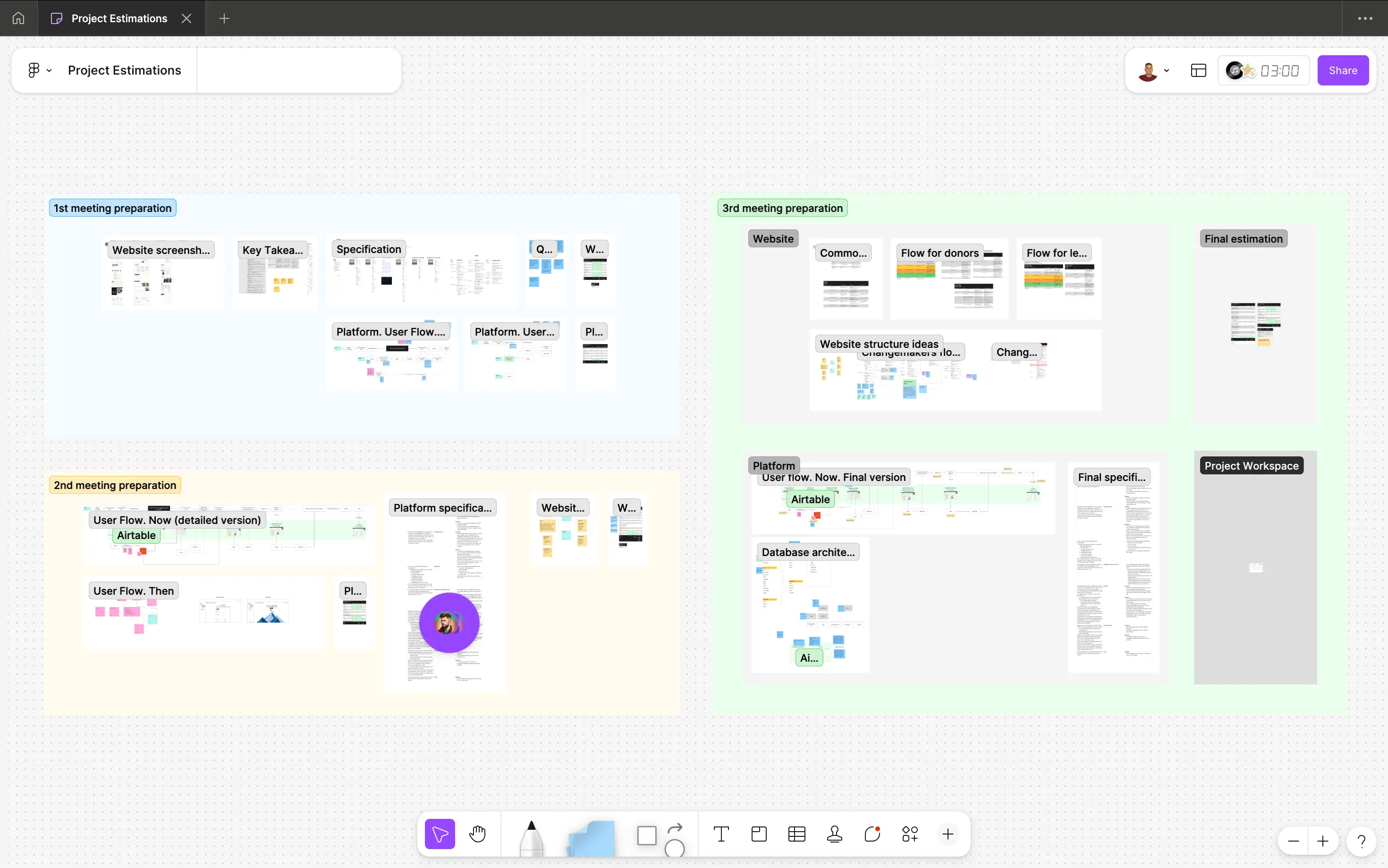
This screenshot shows the estimate we created for a U.S. camp-organization company. The task included a website redesign and, more importantly, a participant platform for screening, collecting pre-event information, and keeping users engaged before the camp begins. It’s a good example of our approach, but keep in mind: every project is different, and your own estimate in Figma may look different.
Why not shift the focus from sending requests to a dozen agencies to having a conversation with a team that’s focused on results? And if, during that process you have doubts about the expertise — great! You’ll avoid the risk of falling for agencies that, like us in the past, focus on creating impressive proposals, not real results.
And if you’re worried about the budget — wondering if we’ll give you a number that doesn’t match your capabilities and you’ll just waste your time — there’s always more than one way to solve a problem. Budget isn’t a roadblock — it’s about finding the right approach.
But yes, our approach does impact the time and cost. We conduct interviews with your target audience, organize the information using the JTBD method, write copy, design wireframes, create concepts, review code, focus on SEO and accessibility, and continue refining the project for three months to hit your target metrics.
For reference, a fully custom website with us starts at $10,000. However, each project is unique, and the cost depends on your specific needs and available resources. For example, startups may not have a client base for interviews, while larger companies may already have marketing teams or copywriters.
So yes, choosing us means you’ll need to dedicate time for communication, but we’ll pay you back tenfold. And in the end, you’ll not only get a reliable estimate, but a loyal team that thinks of itself as Alfred the Butler, with you as the Batman.
How You Get an Estimate for Complex Systems: Web Services and Mobile Apps with a Detailed Spec
Recently, we received a 7-page technical specification from one of our long-term employers, InDrive. They operate in the automotive space, offering a service that allows passengers and drivers to agree on the trip cost directly.
But InDrive isn’t just about rides; they’ve expanded into other areas, including a university faculty.
They came to us with a detailed brief for a web platform that would allow applicants to submit applications, managers to review them, conduct interviews, and ultimately send accepted candidates for enrollment.
At first glance, everything seemed straightforward. But after diving deeper — studying the brief, visualizing the user flow, and discussing the project — we identified 40 key questions that we needed answers to before we could give a confident estimate. Plus, there were 27 more questions that didn’t drastically affect the estimate but were crucial to understanding how the platform should operate at different stages.
Here’s a quick video of what that estimate looked like:
So even if you’ve attached a detailed technical spec, we still need a live meeting. Because it’s not just about reading the spec — it’s about understanding the hidden nuances that aren’t always obvious on paper. Nuances are the key difference between a good result and a mediocre one.
However, if your specification is detailed and cohesive (and, between us, usually that means it’s not written by ChatGPT), we will provide an approximate cost range in our first meeting.
By the second meeting, after processing your answers and refining the MVP, we’ll have a much clearer and more accurate estimate. After the third meeting, both you and we will have a solid understanding of what will be accomplished within the agreed budget, timeline, and key milestones.
Of course, for more complex projects, like mobile apps or web services, we typically need up to 5 meetings to go through all the details and logic.
Yeah, I know. I know exactly what you’re thinking right now. You’re probably planning to send your spec to several agencies and aren’t keen on wasting time on calls with each of them — and that’s exactly why I’m sharing this with you. I want to give you enough information to help you decide if spending 45 minutes with us is worth your time.
Moreover, even if you don’t choose us, this first interview will still help you better understand your own project. We’ll also record the meeting on video, so you can share it with other agencies instead of explaining everything from scratch.
And to get a better idea of how the first meeting goes, check out this article where my partner Alex explains in detail the questions he asks, why he asks them, and how they help with project evaluation: Figure Out What You Really Need Before You Brief
124,614 Tracked Hours. That’s the Real Reason We Can Commit to Your Deadlines and Budget.
We’ve been building products since 2016. Back then it was just the two of us — Paul and Alex — sitting in a café, taking on projects one by one. Over time, the team grew, the processes evolved, and by 2022 the core crew you’ll work with today was finally formed.
Since May 2022, every single minute of work has been tracked in TMetric — every task, every screen, every integration, and everything in between.
Right now, as I’m writing this, the team logs an average of 2,967 commercial hours every month. And from May 2022 to October 2025, that adds up to 124,614 hours of real, measurable work.
That’s why your estimate is reliable — it isn’t based on intuition, it’s based on data.
Of course, we’re not perfect. We haven’t solved every task on earth, and yes, we still make mistakes. But:
we’ve already made most of the big ones. After every milestone, we run a retrospective to understand what went well and what could be improved. And after every completed project, our internal stats get updated. Which means that with every project, our estimate becomes more and more accurate
This is also why you get a guarantee that no matter what happens, you won’t pay more than the estimate. And to make sure unexpected complexity doesn’t affect your timeline, we simply bring more designers or developers onto the project to keep the pace steady.
.webp)
On the left is a screenshot from our time tracker covering May 2022 to October 2025 — I added a magnifier so you can see the number clearly. On the right is a short video our SMM manager, Hanna, made from photos taken throughout the company’s history, from 2016 to today. Fun fact: The first frame is from our very first video shoot — a 1.5-minute clip that took 6 hours due to our inexperience. And since I’m shorter than Alex, I had to stand on a couch cushion to be at eye level!
What Happens After the Contract Is Signed?
So what happens next?
Once the contract is signed, Tanya — our Operations Manager — assembles the team for your project. She looks at your goals, the complexity, the timeline, and matches you with the right people: a manager, designers, developers.
There are no juniors on the team. Over the years, we’ve built a “cross-trained” squad — the kind of team where everyone has their specialty, but everyone also knows how to handle adjacent tasks.
I once read a comparison that stuck with me: a high-performing team is like a special-forces unit — there’s a medic, a sniper, a machine-gunner, but every one of them can perform first aid and fire a rifle.
For three years, I was obsessed with building exactly this structure: processes, quality standards, and a wide rotation of tasks so every team member stays adaptable and sharp.
Now that we’ve become that kind of team, Tanya doesn’t just assign people randomly — she makes deliberate choices based on strengths, weaknesses, and who will fit your project best.
For example, Dennis usually spends more time prototyping platforms (UX). But his design work (UI) wins awards — CSSDA, Awwwards, The FWA — and thanks to him we’ve passed 50+ international design recognitions as a team.
Some developers are stronger in animation, some in React, some in Vue. Tanya considers all of this when forming your project team.
And the very first step your team takes is something we call the Green Table.

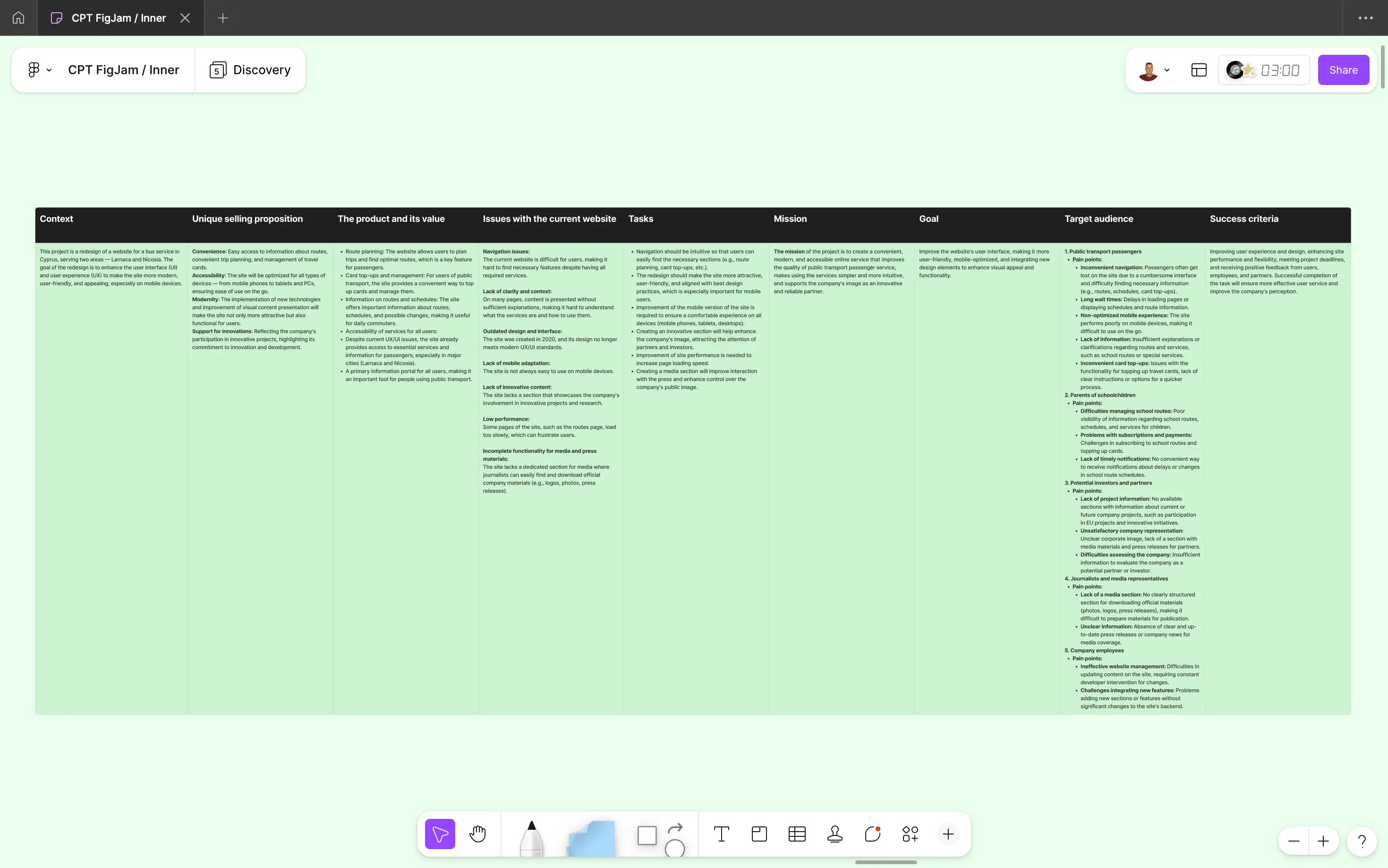
On the left is Tanya, our Operations Manager — she runs daily standups, keeps Jira organized, and assembles the right developers for your project. On the right is the Green Table — a structured summary of your project that every designer prepares and presents before work begins. It ensures the whole team is aligned from day one.
The Green Table is the final output of the Discovery process. Its goal is simple: make sure the entire team understands your project as deeply as Alex and I do after the evaluation phase.
Alex initiates the meeting. He walks the team through everything you and he agreed on: goals, constraints, timelines, budget, and all the context behind the decisions. Then I walk the team through the architecture, the user flows, the structure of the product, the target actions — essentially, the spine of what we’ll be building.
After that, the team studies all the collected information and organizes it into the Green Table — which, ironically, isn’t even green anymore, but the name stuck. Inside it, the team structures the entire input, identifies risks, notes assumptions, and writes down all open questions.
Once the table is ready, the team presents how they understood the project, what edge cases they found, and what questions they still have. Right after that, Alex or the manager schedules a kick-off call with you — a short introduction, final clarifications, and a walk-through of the timeline.
And after that call, the team officially begins the work.
How You’ll Work With the Team Day to Day
The workflow itself deserves its own article (and I’ll write it), but here are the highlights:
- You get weekly progress reports showing exactly where we are relative to the timeline.
- You become part of the team. In the beginning, we’ll have several sync-ups: analysis results → copywriting → wireframes → references → design concepts → key screens. Once we move into development, the number of calls drops significantly — by then everything is already aligned.
- You get support on conversion goals. If the project is conversion-driven, we set up Google goals on your current product before the work starts. And after launch, we keep improving the product for up to three months until the target metrics are reached.
So that’s what happens after your estimate is done, the contract is signed, and the work begins. And if you’re already ready to discuss your project — just leave a request.
We’ll reach out, schedule the first call, and within a few days you’ll have a clear, data-driven estimate — no guesswork, no over-promising, just confidence in the numbers and the timeline.
I won’t promise an easy journey, but you’ll get a transparent process and a predictable result.
But if you’re still deciding whether to reach out — or maybe you’re building a shortlist of teams to talk to — read our article Choosing a Web Studio
It’s based on real stories from employers and breaks down the 5 criteria they used to evaluate teams, why those criteria matter, and how to score each agency fairly. It’ll help you prioritize your list and avoid choosing the wrong partner.
Conclusion
Now you know exactly what happens after you send your brief. You get a clear, data-driven estimate based on a deep understanding of your goals, not just a flashy proposal with a number.
We’ve learned from our past mistakes, and today, our focus is on building honest, transparent relationships. You can trust us to deliver solutions that meet your business needs, not just promises.
If you’re ready to take the next step, we’re here to bring your project to life — with confidence, clarity, and results. Let’s get started.
Thank you for reading — and see you at the kick-off call.
Loyal to you,
Paul from Digital Butlers
About Digital Butlers
We’re Digital Butlers — a design-led team of 27 senior specialists building digital products since 2016. By choosing us, you’re getting results that are way different from what you already have — with the same commitment to your goals that Alfred has for Batman.
If you need a website, web service, or mobile app that pays off, reach out to us — we do it well.
Digital Butlers — a mature team with mature processes that deliver consistent results.


Let’s discuss your next website.
My name is Alex, and I’ll help you define the right next step.