Web & Mobile Apps as a Platform for Growth


Web & Mobile Apps as a Platform for Growth
Discover real cases where smart web and mobile apps became engines of growth, efficiency, and industry leadership—from climate tech to auto dealers.


.webp)
Web and mobile applications are now key tools for scaling businesses and building sustainable competitive advantages. In this article, we share a selection of cases for employers from the USA, Europe, and Central Asia: from a wildfire detection startup to dealership automation and platforms for the services market.
01. Wildfire Detection Platform
In an era of increasingly urgent climate challenges, our team was approached by a startup with a solution capable of transforming the way we monitor environmental risks. The primary goal was to create a digital ecosystem that would enable early wildfire detection and prevention—and serve to attract investors for scaling the initiative.
Task
The main request was to develop a compelling online platform, integrated with smart sensors, not just to visualize the concept, but also to demonstrate its maturity to potential investors. Later, our work expanded as we were also entrusted with design upgrades, creating the entire frontend, deep analytics setup, and building custom alert systems for different risk scenarios.
The entire development cycle took about a year—from the first platform prototype to migrating to a standalone server and launching a set of extended features.
Stages & Technologies
The project began with in-depth user flow design (MVP, step-by-step coordination with the employer’s team). Next, we created a custom design with a focus on 3D visualization and a convenient sensor map—this became one of the keys to creating a “wow effect” at investor meetings.
Key Platform Service Modules
- Interactive map with layers
(active fires from proprietary sensors, data from open external sources, forecasts and risk zones, meteorological data) - Analytics center:
clear history of temperature, humidity, wind, precipitation, and air quality for each sensor and region - Convenient sensor management:
quick status viewing, autonomy, battery, connectivity—all updated in real time - Flexible alert center:
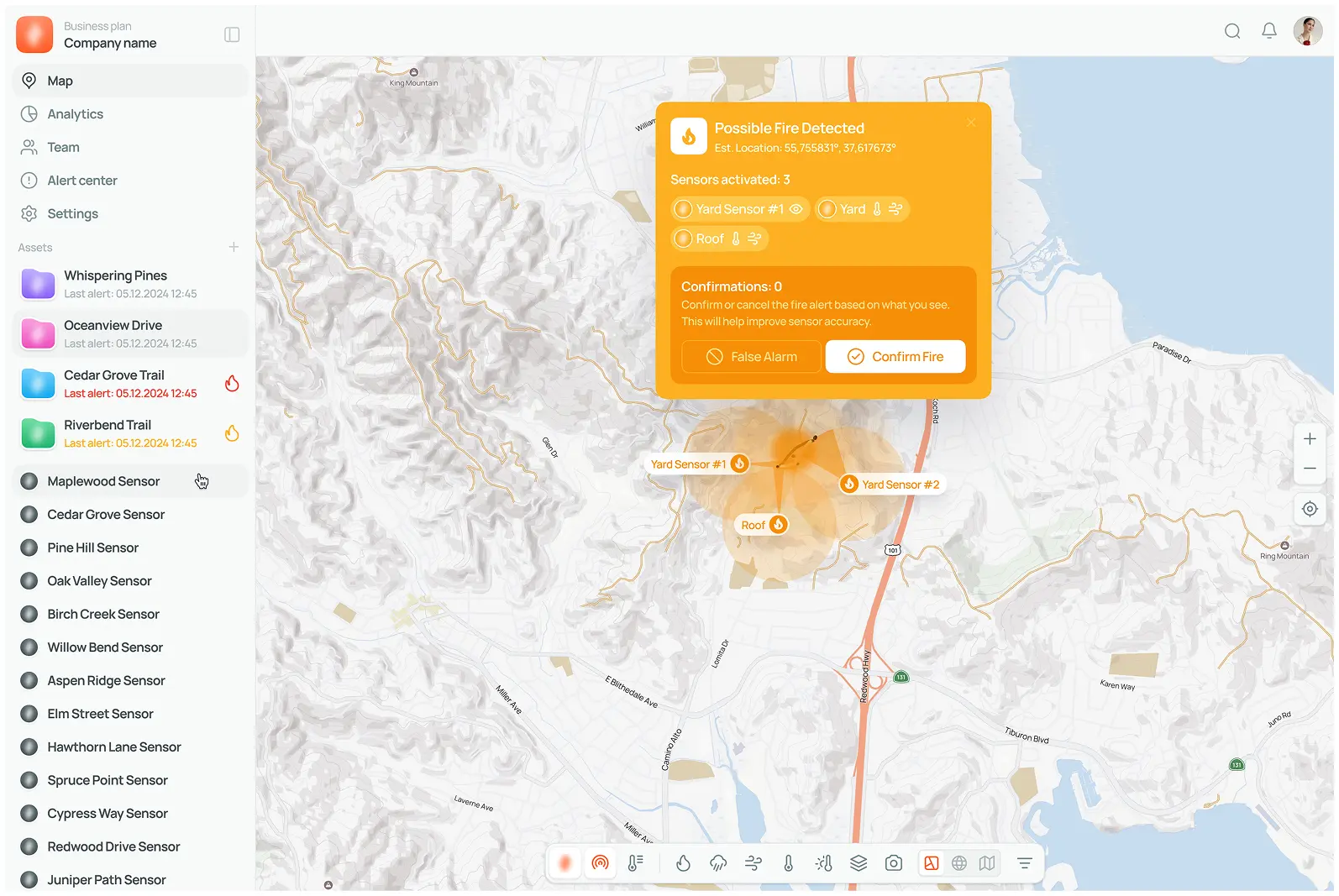
customizable notifications for each user and scenario (fires, smoke, possible ignition, device health, unusual activity, device movement alerts) - Teamwork:
granular user roles and flexible access levels
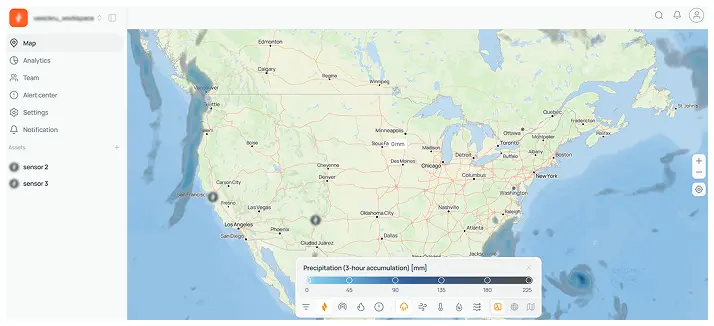
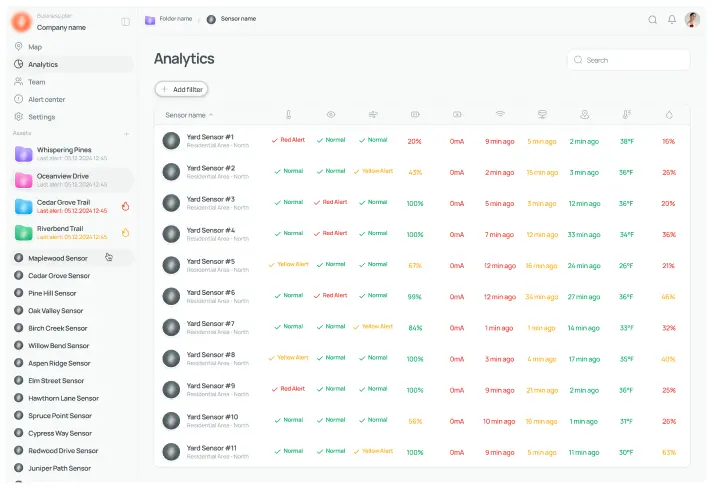
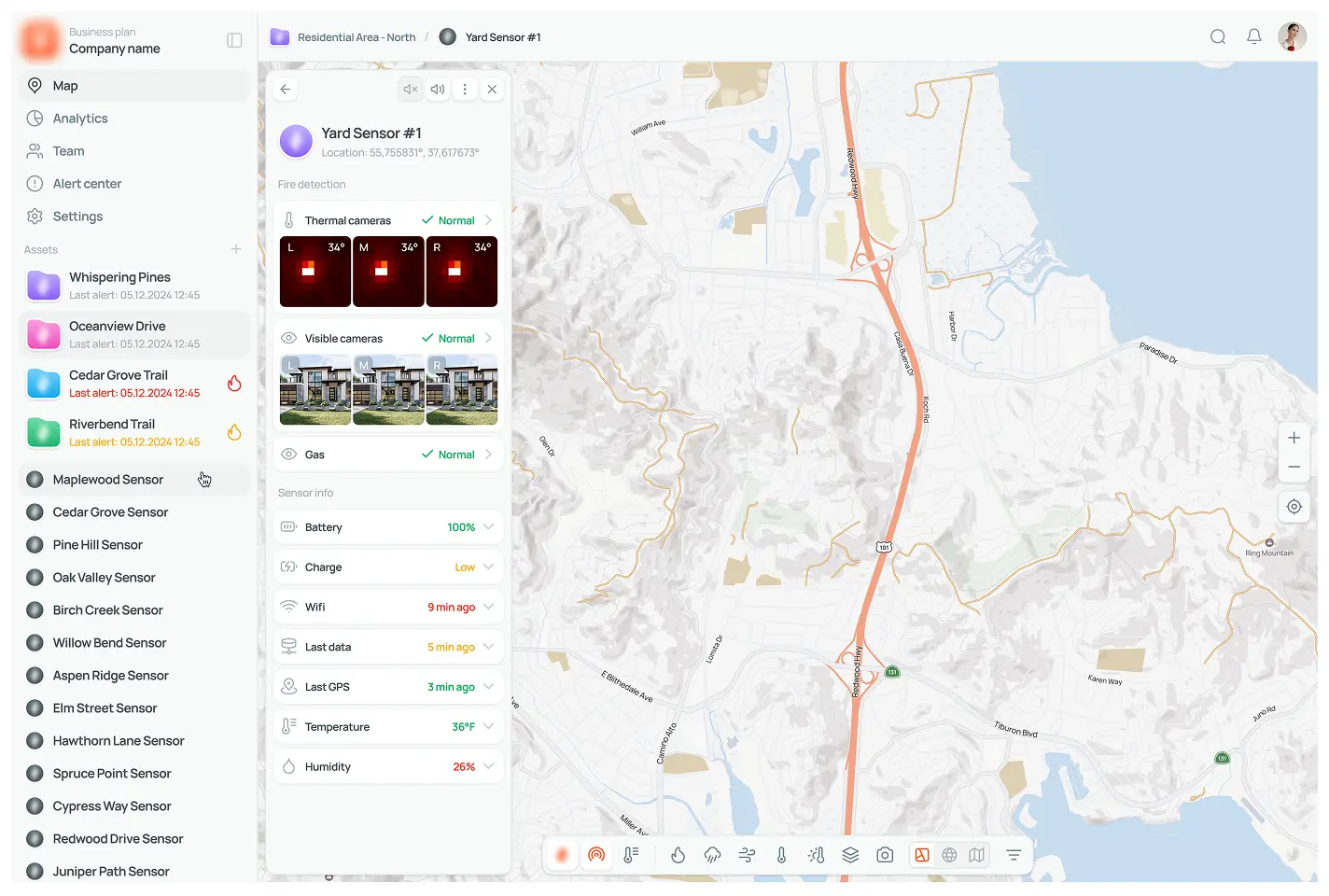
The entire platform was built from scratch using Node.js and Vue.js, fully integrated in real time with external APIs.
Project Highlights
- Geography:
The employer and our team were in time zones 7–9 hours apart, but this never prevented seamless coordination, including overnight “field tests” with live controlled burns at test sites. - Involvement:
Platform testing was thorough: our team not only modeled browser scenarios, but also provided remote responses for real fire events as the employer conducted burns at open locations. - Speed of Changes:
Complex features sometimes had to go from request to release in a matter of hours—for example, adding new visualizations, integrating new external functions, or building custom access options. The team always delivered promptly without compromising quality. - The project team:
Included 3 front‑end developers led by a Front‑end Team Lead, 3 back‑end developers under a Back‑end Team Lead, a QA specialist, and a designer — with up to 7 people working simultaneously at peak load.
.webp)
Platform Features
- Supports various sensor types (thermal, visual, others), running on solar (and grid) power; future support for mobile/SIM connectivity
- Notification system: SMS, email, sound alerts, and calls for critical events
- Customizable alert levels (fire alert, gas alert, yellow alert for temperature/fire risk, device health, “relocated,” etc.)
- Event history: clear analytics per device, filtering by metrics, temperature, date, location
- Support for external data (weather centers, APIs, open-source fire-risk maps, air quality indices, etc.) with custom processing and adaptation
Challenges
- Extremely tight implementation deadlines: sometimes only 3–4 hours for new features or visualizations before investor demos
- Parallel task streams: frontend, backend, and QA working together without sacrificing stability or structure
- Working in real time with large data volumes from diverse sources
- Flexible adaptation to evolving sensor technology (from thermal to visual cameras, changing communication channels)
Result
Our team created a unified ecosystem for precise monitoring, which cut wildfire response times in half and enabled the employer to successfully conduct initial investor presentations. The platform became more than just a monitoring tool; it’s a unique proof of technology maturity, clear for any investor.
For the employer’s team—flexible personnel, sensor, and settings management; for users—a real sense of control over risk at a global scale.
This project gave our team unique experience in fast launches and implementing technologies that can truly change the future of the industry.
02. Wedding Services Marketplace
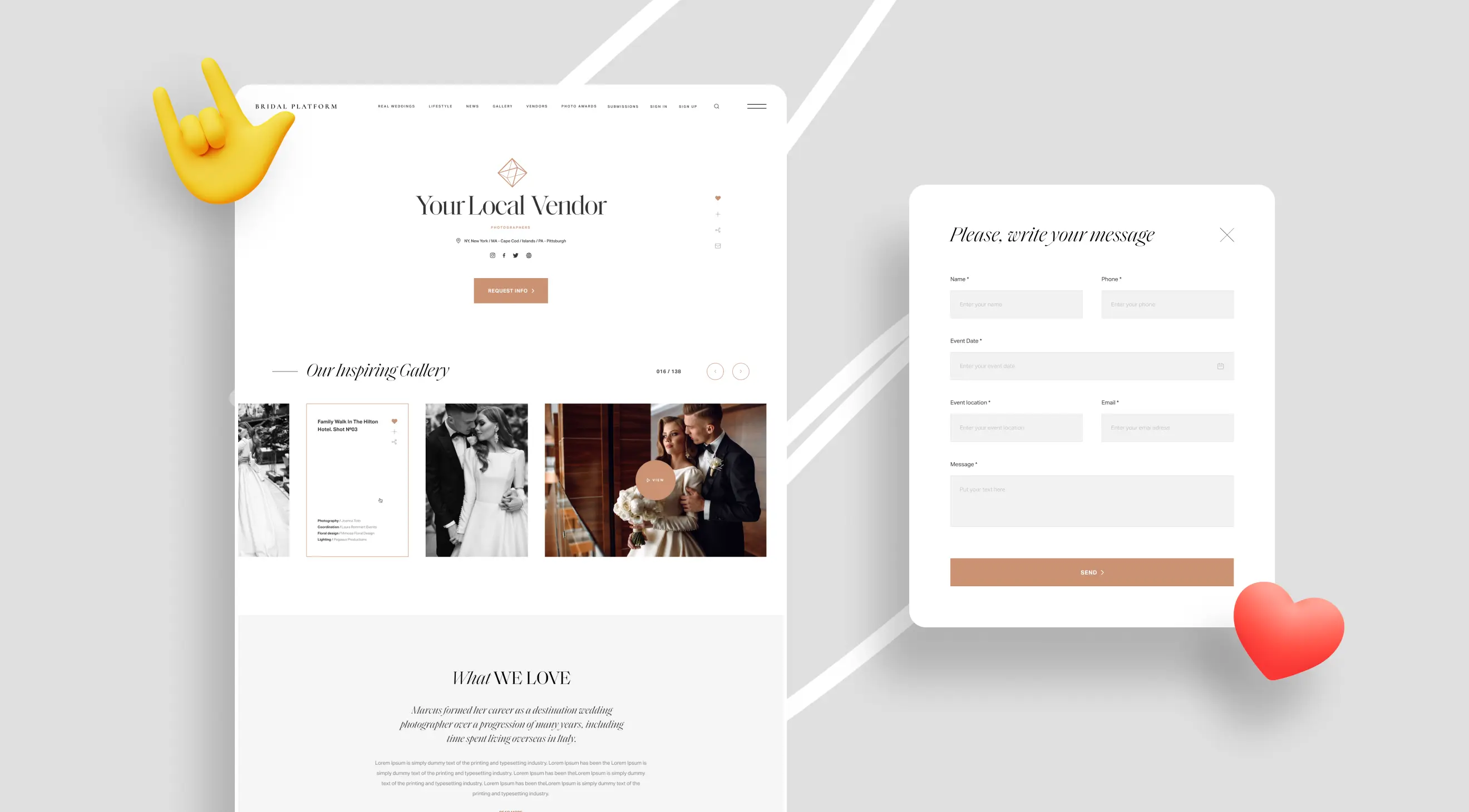
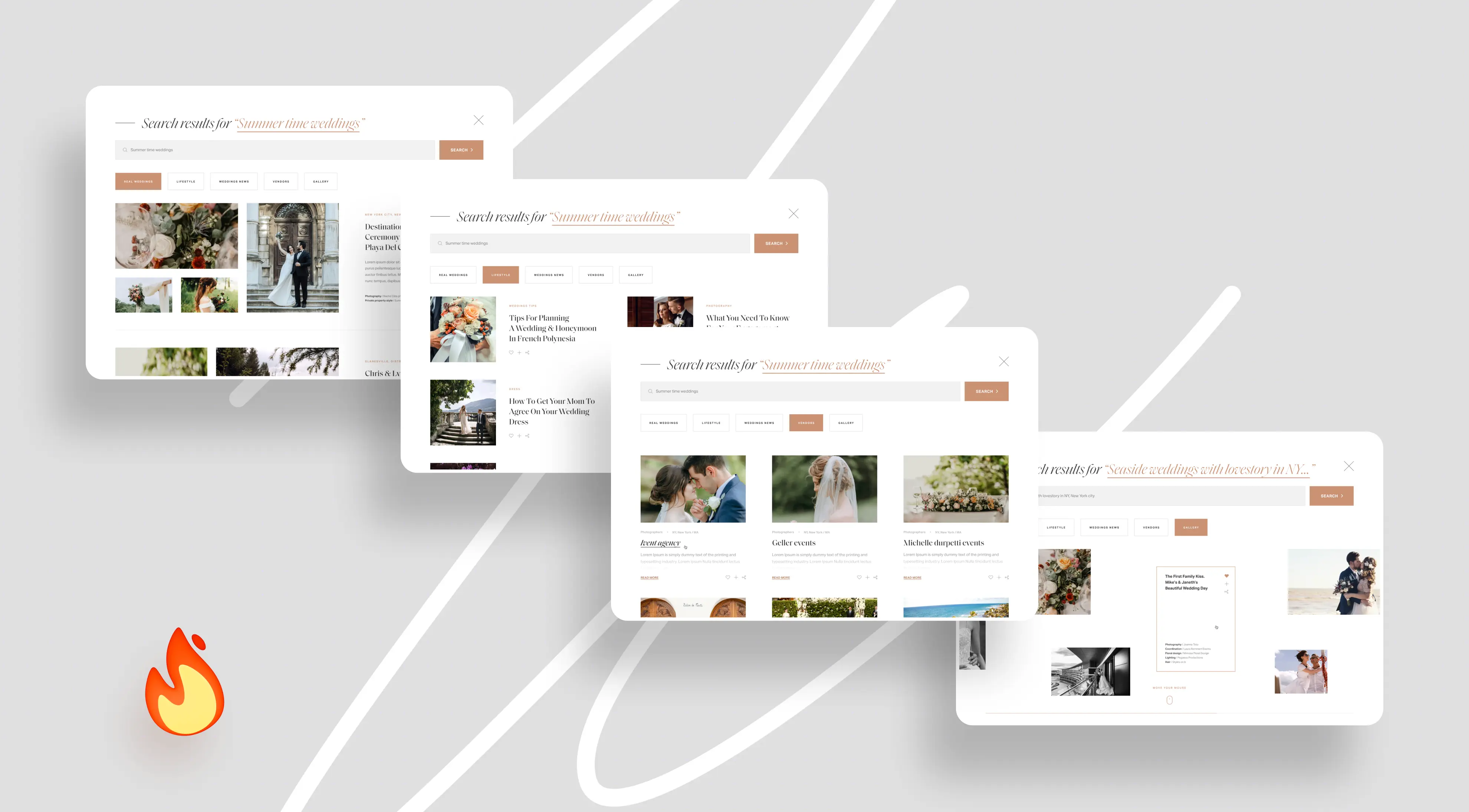
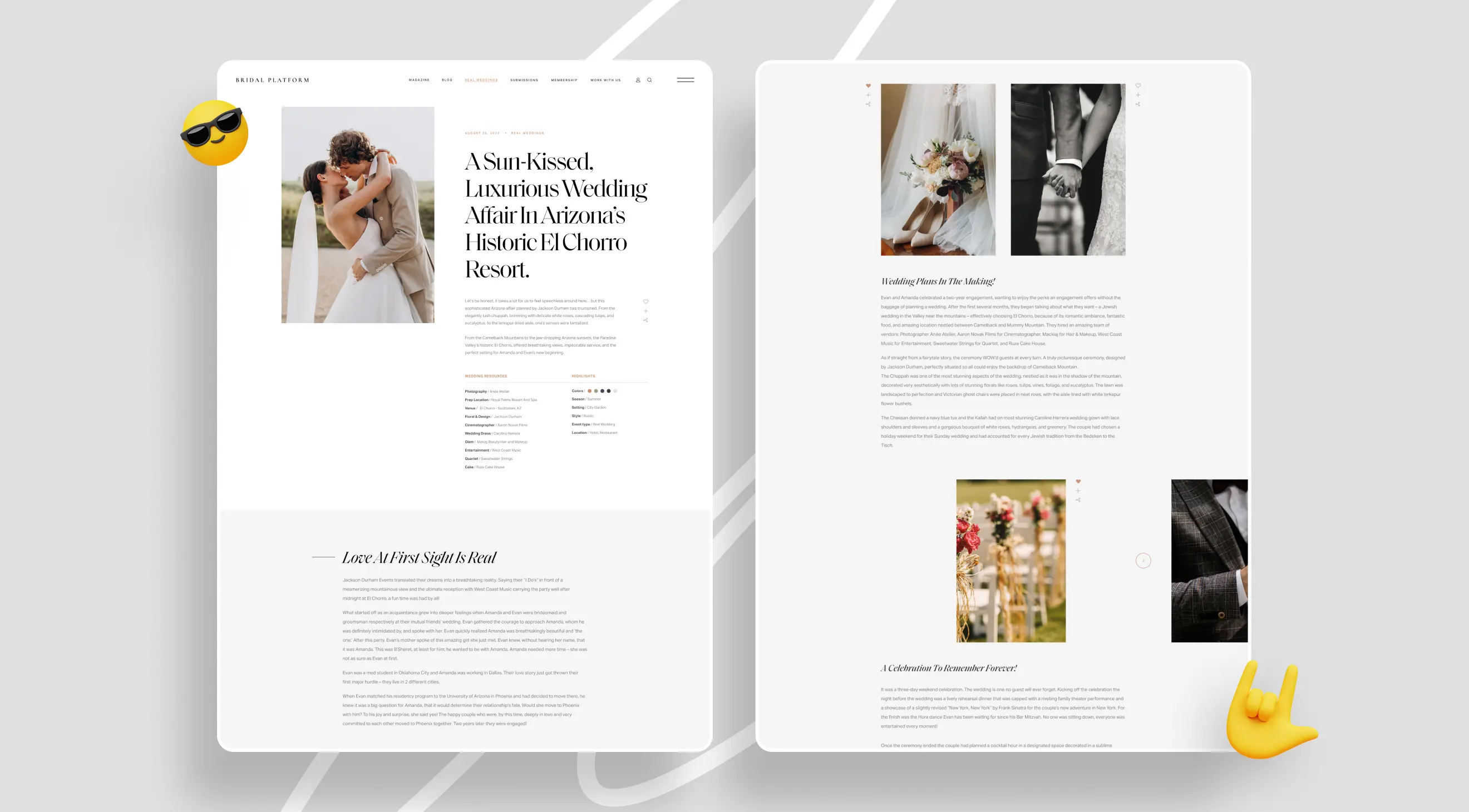
Seeking a modern solution for wedding planning, an employer approached us with the idea of building an online ecosystem for brides-to-be and service vendors—from photographers to makeup artists and florists. The key challenge was to make the selection of wedding services transparent and accessible, and the platform itself both attractive and vibrant, with social network features.
Task
The goal of the platform was to let vendors advertise their services on a paid basis, while brides could find and book vendors in one place, gather inspiration, and contact providers quickly. The project was designed as a digital marketplace with social network elements and an easy, user-friendly experience.
Process & Stages
Development started in 2020 using a modular approach—case by case, with a thorough breakdown of user flows:
- Authorization and profiles:
separate for brides and vendors, with registration, profile creation, portfolio upload, and contact setup - Search and filters:
powered by intelligent ElasticSearch that recognizes typos, suggests relevant services, and adapts to preferences (category, rating, popularity, price, etc.) - Messenger:
built-in chat for brides and vendors, instant file transfer (contracts, media) - Catalogs & collections:
the ability to curate, save, and comment on favorite photos, portfolios, and services, and build themed collections like Pinterest - Booking management and contract signing:
instant specialist booking, online document sending and signing - Ratings, likes, and promotions:
higher vendor ratings (likes, successful bookings) mean higher visibility in search; paid promotion available - Payment system:
Stripe integration for seamless payments in the US - Bunny CDN:
rapid browsing and upload for thousands of photos and media—perfect for portfolios and large image collections
Development was handled by two frontend developers, two backend developers, and a designer, who tackled key modules in parallel and delivered each version quickly for testing.
.webp)
Project Highlights & Technology
- Every module was “battle-tested” live and refined based on feedback—this meant flexibility and near-instant MVP delivery
- ElasticSearch was deeply integrated for the first time: search across services, photos, collections, and reviews felt “human” and was lightning fast, even at huge data volumes
- Stripe enabled both subscriptions and one-off payments
- Bunny CDN was the key for high-speed uploads of extremely large media catalogs, with no layout or performance lag, even on mobile
Team Experience
- The project evolved as a series of independent product cases—from core profiles to a sophisticated system for collections, service booking, filters, and chat.
- Over two years, the team contributed more than 9,000 hours—almost the entire planned functionality was delivered on time.
Result
The final result was a modern digital marketplace—a flexible professional space for brides and wedding service vendors, with quick search and advanced communications, where everyone in the ecosystem could achieve their goals:
- Vendors could find clients, promote services, grow their portfolios, and gather feedback.
- Brides could explore, compare, save, and book vendors they liked, collect inspiration, and arrange their dream wedding directly.
The platform marked a new step for our team in developing products that solve real-market challenges—at the highest pace, quality, and flexibility in digital.
This experience provided a solid technological and organizational foundation for our future digital-platform projects.
03. Mortgage Marketing Ecosystem
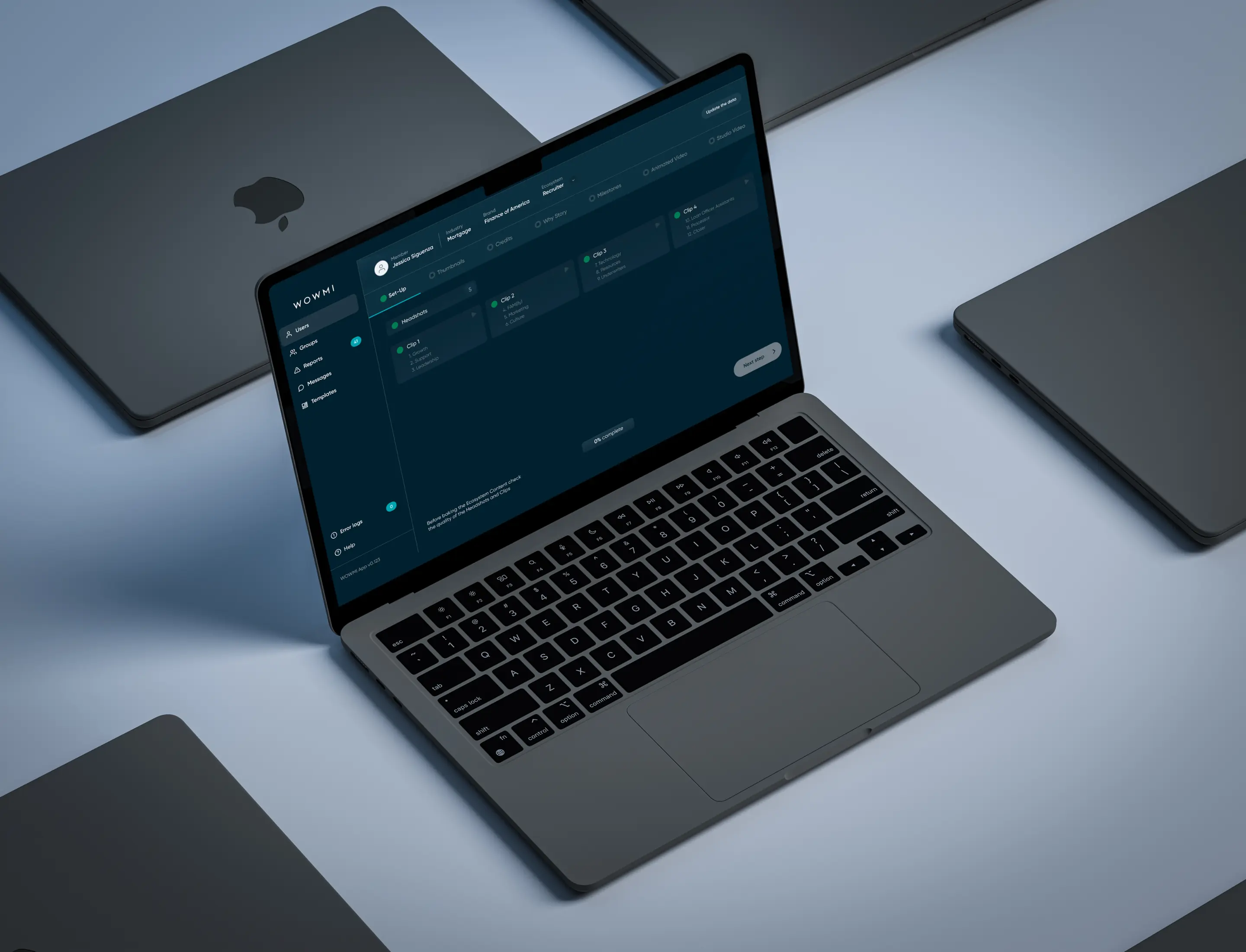
WOWMI is a US marketing agency helping mortgage consultants boost their personal brand, attract clients, and automate lead generation.
For this employer, we developed three key products: Website Builder, Site Rebranding, and Postproduction Builder.
.webp)
Task
It started with WOWMI’s designer inviting us to help develop their in‑house product — digital business cards for hundreds of mortgage agents nationwide. Initially, our task focused on front‑end implementation for the existing layouts, but as the project grew, we also began contributing to design improvements and feature development. These one‑page sites were needed for:
- Market positioning (unique personal landing pages)
- Publishing educational content and automating lead generation
Originally hosted on Webflow
Originally, WOWMI provided its agents with personal landing pages hosted on Webflow — we were initially brought in to implement front‑end layouts for these one‑page sites. Over time, as our cooperation deepened, our team also began handling design improvements and launching new websites on a regular basis.
For nearly two years, this setup worked in manual “production mode”: hundreds of agent sites were created one by one, even though up to 90 percent of their structure and content were identical. This revealed several major challenges:
- High cost:
each site required a paid Webflow CMS plan (about $24 per month per site), which became prohibitively expensive at scale. - Limited scalability:
even with similar templates, each new agent site had to be manually copied in Webflow and filled with data through the CMS, often causing template errors that required developer fixes. - No batch deployment:
even with similar templates, building and publishing each new site still required developer time and manual effort from our team.
In the end, the employer was spending substantial resources on repetitive website creation while growth was constrained by the manual production process. That’s when we proposed building a custom Website Builder — a tool capable of automatically generating thousands of agent websites in minutes from a simple CSV or spreadsheet containing each agent’s personal data (name, photo, license number, and contact details).
“Back then, I was constantly hooking up third‑party tools — CRMs, analytics, you name it. All the sites shared the same template, and I kept doing the same tasks over and over again. At some point it just clicked: if we could merge everything into one system and pull each agent’s data from a single database, we’d only have to set up integrations once instead of a hundred times. That’s how the idea for our Website Builder came about — a platform where any template update automatically rolls out across every site.”

Employer’s Goals:
- Automate the creation and maintenance of hundreds of agent landing pages.
- Bring the process in‑house so that internal teams could quickly generate personal sites for any brand —including custom colors and logos—without relying on external developers.
- Transfer knowledge and management tools to WOWMI, ensuring they could handle day‑to‑day updates independently instead of requesting every minor change.
Process & Stages
Stage 1 — Website Builder
The first step was to create a system capable of generating hundreds of personal agent websites within minutes. We built a centralized admin dashboard where the employer could upload a CSV file (for example, exported from Google Sheets) with agent data.
The system then:
- automatically parsed the CSV and instantly created personal sites for new members;
- enabled management of unique domains for each agent;
- provided easy controls to add, hide, or update blocks, educational videos, and text modules — all centralized, no coding required;
- integrated auto‑pulling of media assets, so when agents or admins uploaded videos, they appeared on the websites automatically.
This stage turned a completely manual Webflow‑based process into an automated, scalable pipeline that could deploy new websites in minutes rather than days.
.webp)
A custom web service that automatically generated hundreds of agent websites from a single CSV file — reducing operational overhead and significantly lowering Webflow costs. The system later expanded into full template management and video editing capabilities.
Stage 2 — Site Rebrander
After we launched the Website Builder, creating one site now took around 30 seconds instead of 8 hours — a huge leap in efficiency. However, all agent pages were based on a single design template, meaning colors, fonts, and overall style remained unified. As more mortgage companies joined the WOWMI ecosystem, each brought its own brand identity and required unique visual adjustments. For every new partner, a Webflow developer still had to create a separate design template, which could take two to three days. These limitations highlighted the need for a tool that would let managers adapt existing templates to new branding without developer input — that’s when we began developing the Site Rebrander.
The new rebranding tool was embedded directly into the admin dashboard. In just a few clicks, managers could:
- adjust brand colors, fonts, and logos;
- duplicate templates and adapt them for new brands or agencies;
- instantly apply updates across multiple sites.
This upgrade removed the most time‑consuming manual edits and gave WOWMI complete control over brand presentation for every partner. At the same time, it significantly reduced business costs associated with creating new templates and accelerated how quickly new brands could be onboarded into WOWMI’s ecosystem—opening up fresh business opportunities and reinforcing the platform’s reputation as a scalable, growth‑driven solution.
Stage 3 — White‑label and Rollout for Other Employers
By the time the Website Builder and Site Rebrander were complete, WOWMI had a powerful internal system that could create and manage hundreds of agent sites automatically.
But those same tools also revealed a new strategic direction: what if this technology could be installed and used by other mortgage companies under their own brand?
That goal defined the next stage — preparing the Builder ecosystem to operate as a white‑label product. We refactored the architecture so it could be deployed on separate servers for different clients, with isolated databases, brand assets, and admin panels. This approach turned WOWMI’s internal software into a scalable “program” that each buyer could host independently.
Once integrated, the Builder became a complete white‑label solution.
Partner companies could:
- fully customize the interface, colors, and domain structure;
- manage their own agent data;
- host the platform on their infrastructure without relying on WOWMI’s servers.
This shift opened a new revenue channel — licensing and distributing the Builder to other mortgage groups.
The first adopter, Prosperity, now runs the system to manage more than 400 agents, realizing exactly what WOWMI initially envisioned: a self‑sufficient, branded, and rapidly deployable digital infrastructure.
Stage 4 — Postproduction Builder
After launching the Website Builder, Site Rebrander, and completing the white‑label rollout, only one part of WOWMI’s workflow remained fully manual — photo and video content creation.
This work was managed by a dedicated production team, and it turned out to be both slow and expensive. Since all agent visuals followed similar patterns, Daniel from WOWMI proposed developing a system that could automatically generate photos and videos using predefined templates. That concept evolved into the Postproduction Builder — a tool designed to automate the generation of branded content.
We built a separate editor that allowed:
- uploading source photos and videos from shoots;
- applying animation templates, transitions, and branded titles automatically;
- exporting fully customized and ready‑to‑publish video content for agent websites — essentially a Canva/CapCut‑like system purpose‑built for WOWMI’s workflow.
Although the initial implementation covered only the core functionality, the foundation for full automation was established. The tool proved that creative production could be systematized and scaled within the Builder ecosystem — marking the final step toward a complete digital platform for WOWMI and its partners.
“WOWMI turned out to be a massive project with countless internal directions. When I joined Digital Butlers, my first experience was the Post‑production Builder — at that time, I barely understood the system, but the deeper I got, the more I admired its scale and automation. Over time, I came to understand the product inside and out, knowing its processes as deeply as the client’s own team. This project became a true school for me — from logic and workflow to release management. I’m deeply grateful to the team and to Daniel for their trust, patience, and the invaluable experience I gained along the way.”
.webp)
Project Highlights
- Deep immersion:
by living inside the employer’s daily workflows, we discovered opportunities for automation that weren’t visible at first. This experience shaped our identity as “Alfreds” — always curious, proactive, and invested in our partners’ success. - Adaptive delivery:
while some milestones took longer than planned, our agile process allowed us to release functional updates weekly during active development phases, keeping stakeholders engaged and the product steadily improving. - Fast‑moving priorities:
as WOWMI’s sales team kept closing new deals faster than we could deploy, priorities shifted almost weekly. It taught us to stay agile, reprioritize on the fly, and build features directly in sync with business momentum — not against it. - Cost efficiency:
the Builder replaced multiple hosting setups, consolidating all sites on a single server and saving tens of thousands of dollars annually.
Platform Features
- Automation:
Instantly create multiple sites from CSV/Google Sheets, each with its own domain. - Editability:
Easily mass-update templates (colors, logos, fonts). - Centralized content management:
Quickly add/edit training content, videos, and auto-upload to sites by folder. - Built-in white-label admin:
Each corporate employer gets their own branded dashboard (e.g., Prosperity). - Webflow integration:
For emergencies, individual sites or templates could be exported to Webflow with auto-created pages via API. - (Planned) Video editors:
The postproduction builder was envisioned as an internal template video service.
Challenges
- Evolving architecture:
the platform had to balance familiar visual workflows from Webflow with the need for scalable automation. Each iteration brought new insights into how to preserve creative flexibility while reducing manual steps — turning architectural volatility into a learning driver. - Shifting priorities and resource balance:
rapid business growth meant focus often shifted toward features tied to new partnerships or sales opportunities. The team learned to adapt roadmaps dynamically, ensuring short‑term demands contributed to long‑term platform stability. - Cross‑platform data flow:
parallel development across legacy Webflow sites and the new Builder infrastructure demanded advanced API integrations and synchronization pipelines — essential groundwork for the later white‑label rollout. - Scalability and support readiness:
mass site generation quickly tested the limits of monitoring, updates, and maintenance. Establishing a sustainable support model became a critical step before launching the platform to partners like Prosperity.
Result
WOWMI received a unique digital toolkit that reduced Webflow commission costs by about a thousand dollars per month and allowed internal teams to launch and manage hundreds of agent sites independently. The creation of new websites now takes minutes instead of weeks, which directly increased the company’s sales capacity. The new platform became the basis for a white‑label product that WOWMI could package and sell to other mortgage agencies, opening an additional revenue stream, while the Postproduction Builder cut time and expenses for photo and video content production.
The ecosystem remains active: part of the infrastructure still integrates with Webflow; part is maintained on the agency’s server.
“For startups like this, it’s vital to think for the long term: if you’re building a web service, plan for flexibility in scaling (web/mobile apps). And always “watch the money.” We recommend Mike Michalowicz’s “Profit First”—WOWMI’s experience clearly shows that a well-thought-out financial strategy is what helps businesses survive crises and keep moving forward.”

.webp)
Our experience with WOWMI clearly demonstrated our ability to not only think strategically about complex problems, but also implement agile solutions that power business growth. By diving deep into the employer's business processes, we brought new website launch times down from weeks to just minutes and reduced hosting costs by an order of magnitude.
The digital ecosystem we developed enabled the employer to scale their service to hundreds of users and optimize expenses on the fly, bringing automation and flexibility to a whole new level.
This result catalyzed the creation of scalable digital products for other corporate partners in the US and solidified our expertise in building custom solutions with a future-oriented vision.
04. Olamavto — Dealership Automation
Olamavto is one of the largest official Chevrolet dealerships in Uzbekistan, and it set out to achieve a fundamentally new level of service automation. Unlike traditional dealerships that focus on diverse sales models, Olamavto works exclusively on a trade‑in system—offering clients the chance to exchange their old Chevrolet vehicles for brand‑new models.
.webp)
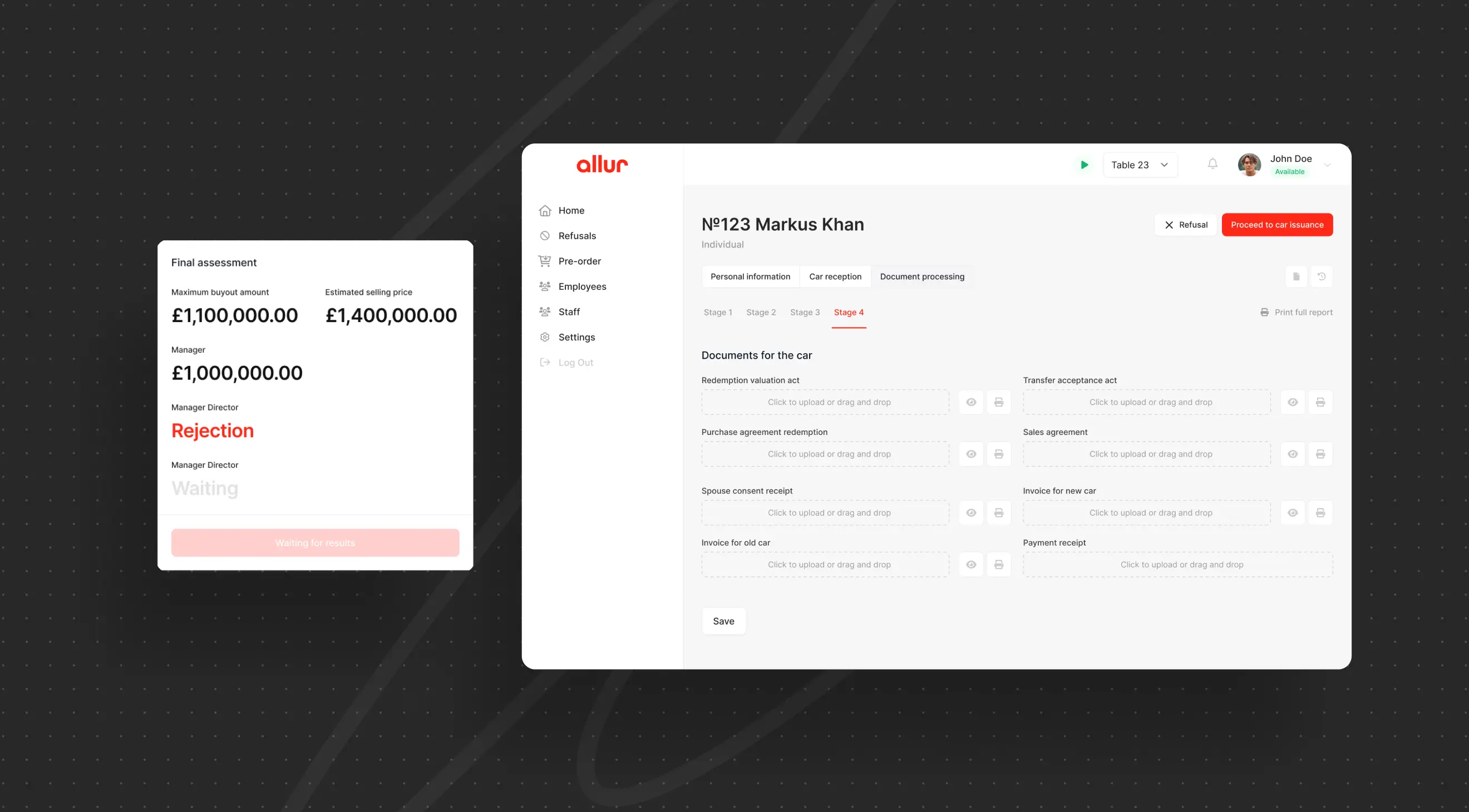
The employer’s request was clear: they needed not just a website or a catalog, but end‑to‑end digitization of all core business processes. This included managing customer flow, automating communications, enabling real‑time tracking, and completing transactions seamlessly without paper-based operations—turning the trade‑in process itself into a modern, fast, and fully digital experience.
Task
The employer’s goal: not just a sleek interface, but a system fully integrated with all business processes.
The platform had to automate client registration and electronic queueing in the showroom, ensure seamless application processing by the dealership manager,
enable transparent trade‑in evaluation of used vehicles by in‑house mechanics, support instant loan processing through an on‑site partner bank,
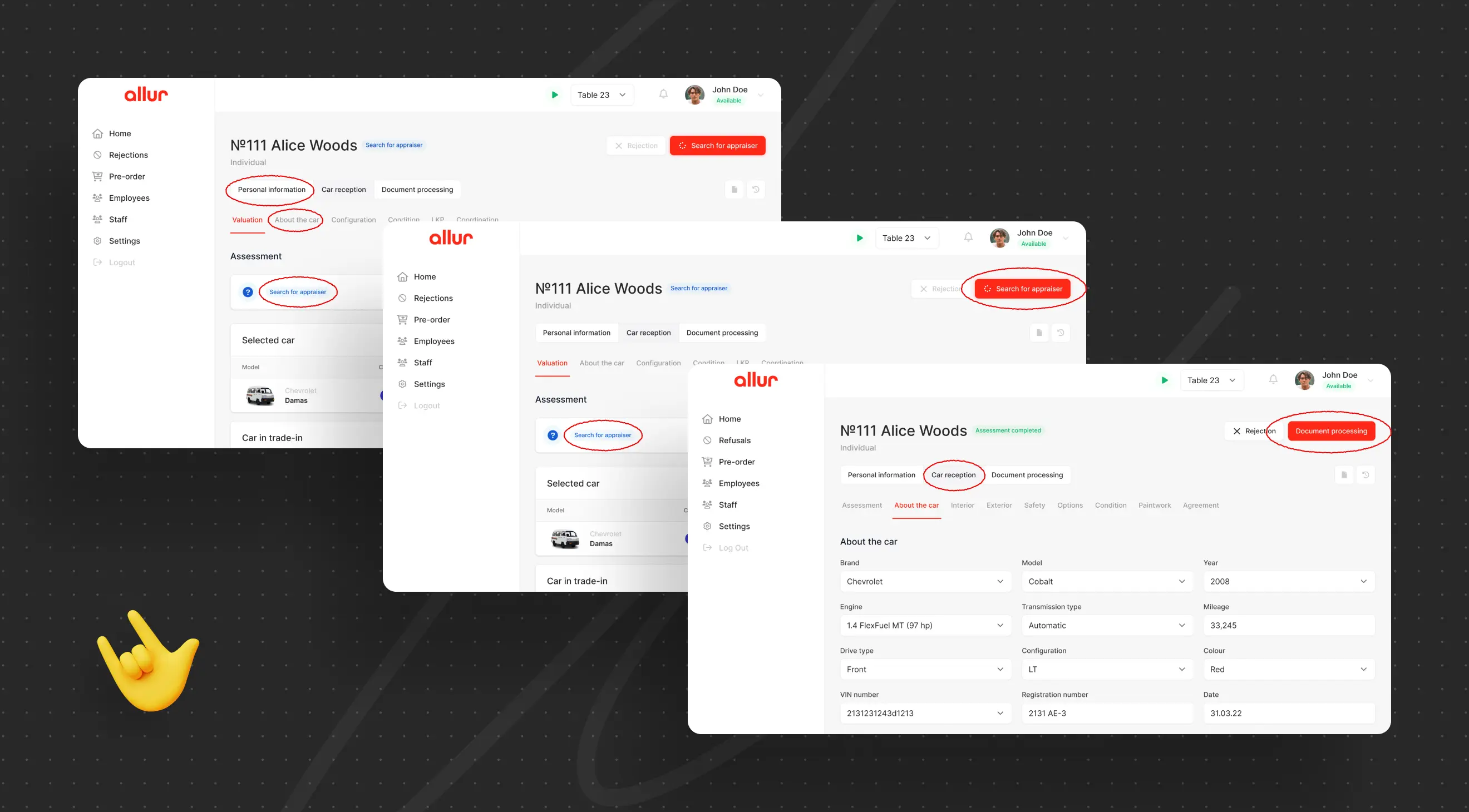
streamline buy‑back price approval by the deputy director and general manager, and finalize the process with digital execution of the purchase and sale agreement by a sales manager — covering the entire paperwork cycle end to end.
A key requirement was rapid deployment directly inside the dealership, fully tailored to the staff’s real work processes and flows — with the additional challenge of completing the entire implementation within just three months.
Process & Stages
- Interface design and customization: The system was developed from scratch: unique user journeys, internal logic, and alignment of external UX and admin tasks.
- Custom admin panel: Built specifically for the employer’s needs—inventories, promotions, transactions, and internal analytics available in one dashboard.
- Electronic queue implementation: Enabled automated client intake: visitors receive a QR-ticket on-site and are immediately routed into the digital system.
- The service automatically distributes workload among managers, detects bottlenecks, and helps optimize customer interactions.
- Trade-in and loan process automation: The platform features a trade-in module so that clients can instantly see preliminary values by VIN.
- Every stage—trade-in request, loan approval, document generation—is automated. The credit application area is tightly integrated: applications are submitted from the dashboard, responses come in automatically, and all agreements are generated and distributed without manual steps.
- On-site deployment and live support: Our developer worked directly at the employer’s location. About 80% of the workflows were adapted “in the field” to address dealership staff’s unique processes.
This approach allowed us to eliminate any gaps and automate workflows in tune with actual demand and daily tasks.
Project Highlights & Technology
- All features were built from scratch and aligned to the employer’s true needs—not abstract scenarios.
- Most of the IT solution was launched in direct, real-world practice—with improvements following staff feedback.
- The full suite of tools (electronic queue, trade-in, loans, document flow) achieved true end-to-end automation—from client entry to contract signing.
- To ensure smooth adoption, one of the back‑end developers spent two weeks on‑site at the dealership—overseeing the platform rollout, helping staff learn the new tools, and fine‑tuning critical features directly in a real working environment.
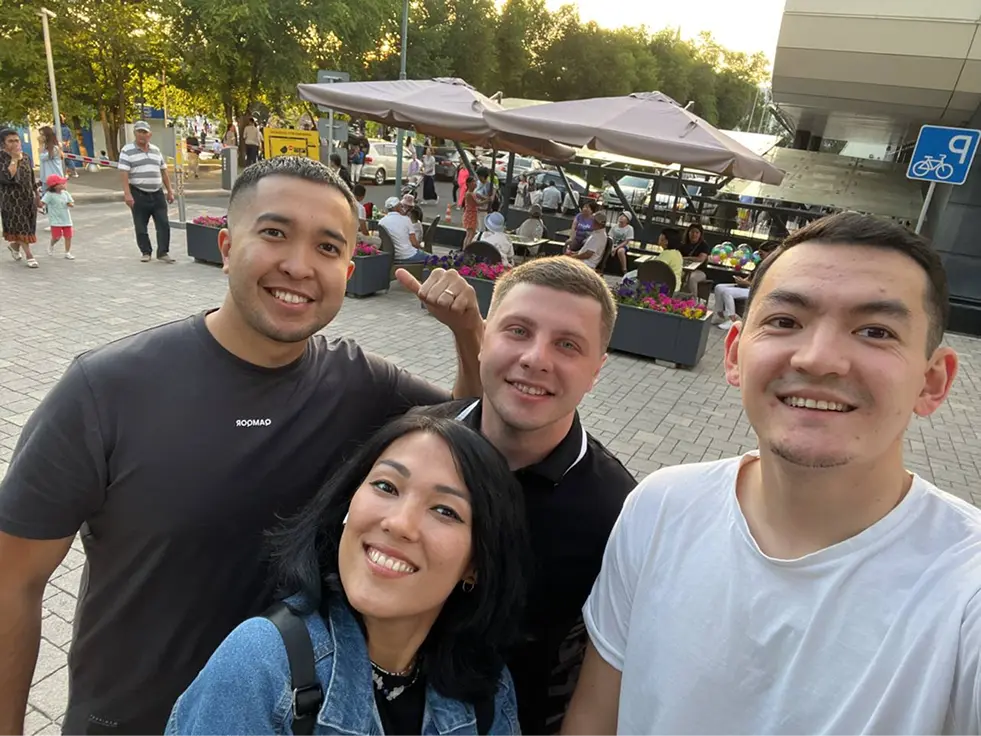
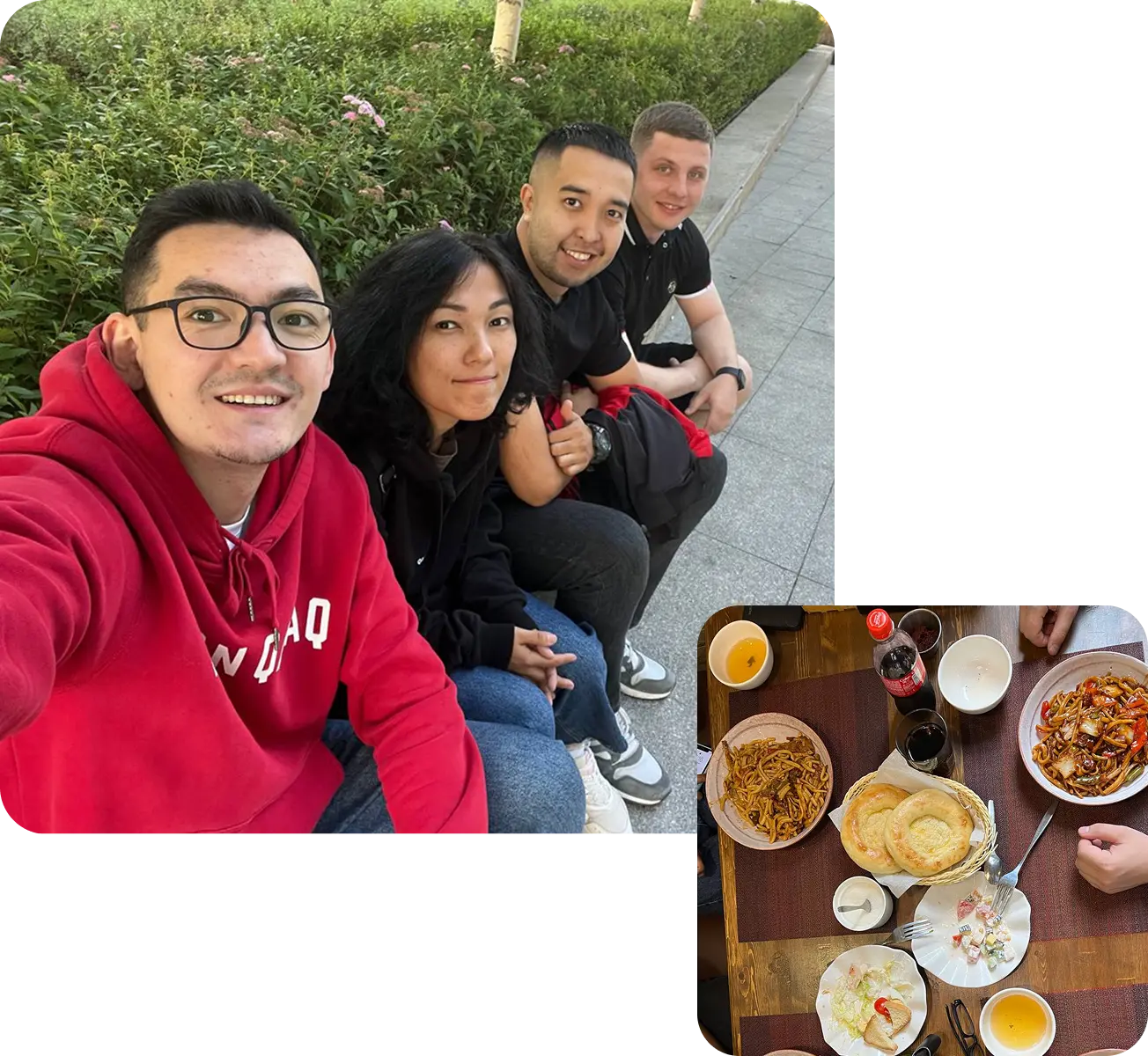
“Thanks for the warm welcome: Arsen, Zhanel, Azamat and everyone else – you are just awesome. For me, it was valuable to implement the result of our work in real conditions. It taught me to better understand the difficulties our employers face during implementation, and thanks to this experience the project go‑live stage acquired its own standards of quality and requirements.
%20(1).webp)
Platform Features
- Full customer registration and processing — including electronic queueing and all‑digital paperwork
- Automated trade‑in workflow, loan processing, and smart task assignment among managers
- Unified admin dashboard for inventories, deals, offers, and transactions
- Instant generation and secure distribution of agreements to clients, banks, and accounting
- Real‑time task routing: the very instant a manager clicks “send for appraisal”, a new ticket instantly pops up on a mechanic’s iPad at the other end of the building — ready to be accepted and used to evaluate the car on the spot
Challenges
- Need to upgrade processes quickly “on the fly” at the employer’s office, given real traffic and live team needs
- Merging advanced digital workflows with traditional “office” routines, without losing efficiency
- Balancing feature richness and deep customization with the goal of full automation for day-to-day processes
- Delivering all of the above under a strict 3‑month deadline, turning every iteration into a race against time
Result
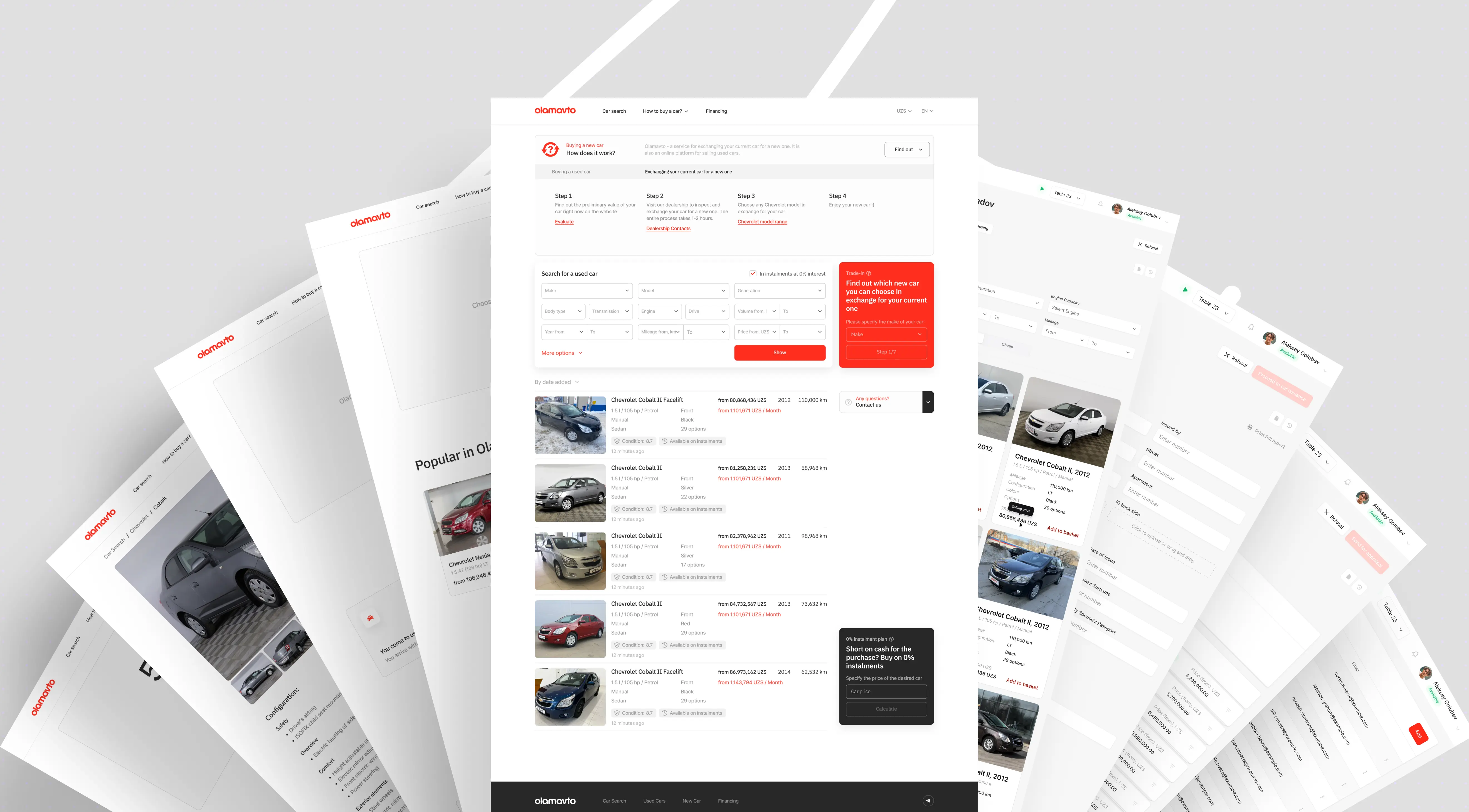
The employer received a full-featured CRM platform bringing together every workflow—clients, deals, services, documents, and payments—under one digital core.
The system minimized human error and removed bottlenecks: every next step is suggested by the system, and all document preparation, sending, and storage are automated.
The platform is designed for scalability, supporting business growth and rapid deployment of new features, integrations, and automation modules as needed.
Conclusion
Web and mobile apps are no longer just technical tools—they’ve become growth engines for entire industries. From environmental safety and wedding marketplaces to mortgage agencies and auto dealerships, our cases show how digital ecosystems can accelerate operations, reduce costs, and open new opportunities for scale. The lesson is clear: investing in agile, well‑designed platforms today means building a stronger, more resilient business for tomorrow.
Awards
About Digital Butlers
We’re Digital Butlers — a design-led team of 27 senior specialists building digital products since 2016. By choosing us, you’re getting results that are way different from what you already have — with the same commitment to your goals that Alfred has for Batman.
If you need a website, web service, or mobile app that pays off, reach out to us — we do it well.
Digital Butlers — a mature team with mature processes that deliver consistent results.
"The dedication it takes to show up day in and day out is what has impressed me the most about this company."
One of the best parts of my day is finding out how we progressed in our mission. The dedication it takes to show up day in and day out is what has impressed me the most about this company.
You will never progress in business if you don't have a team that is consistent. You will never progress in business if you don't have a team that is dedicated. They are both.
Location

USA
CA
Project length
Mar. - Dec. 2022
Location

CA, USA
Project length
Jan. 2019 - Ongoing



Quality:
5.0
Schedule:
5.0
Cost:
5.0
Would Refer:
5.0
"They didn't just deliver a website they crafted an immersive digital experience that reflected our concept's essence."
They didn't just deliver a website; they crafted an immersive digital experience that reflected our concept's essence.
What struck us most about Digital Butlers was their ability to blend creativity with technical expertise seamlessly. The team demonstrated adaptability and responsiveness to our needs, ultimately delivering a website that aligned with our company.
Location
Location

Kazakhstan

Quality:
5.0
Schedule:
5.0
Cost:
5.0
Would Refer:
5.0


Let’s discuss your next website.
My name is Alex, and I’ll help you define the right next step.

.webp)